In a linear simple harmonic motion $(SHM)$
$(A)$ Restoring force is directly proportional to the displacement.
$(B)$ The acceleration and displacement are opposite in direction.
$(C)$ The velocity is maximum at mean position.
$(D)$ The acceleration is minimum at extreme points.
Choose the correct answer from the options given below :
JEE MAIN 2023, Medium
Download our app for free and get started
$F =- kx \text { A true }$
$a=-\omega^2 x B \text { true }$
$\text { Velocity is maximum at mean position } C \text { true }$
$\text { Acceleration is maximum at extreme } D \text { false }$
$\text { points }$

Download our appand get started for free
Experience the future of education. Simply download our apps or reach out to us for more information. Let's shape the future of learning together!No signup needed.*
Similar Questions
- 1A particle of mass $m$ is attached to one end of a mass-less spring of force constant $k$, lying on a frictionless horizontal plane. The other end of the spring is fixed. The particle starts moving horizontally from its equilibrium position at time $t=0$ with an initial velocity $u_0$. When the speed of the particle is $0.5 u_0$, it collies elastically with a rigid wall. After this collision :View Solution
$(A)$ the speed of the particle when it returns to its equilibrium position is $u_0$.
$(B)$ the time at which the particle passes through the equilibrium position for the first time is $t=\pi \sqrt{\frac{ m }{ k }}$.
$(C)$ the time at which the maximum compression of the spring occurs is $t =\frac{4 \pi}{3} \sqrt{\frac{ m }{ k }}$.
$(D)$ the time at which the particle passes througout the equilibrium position for the second time is $t=\frac{5 \pi}{3} \sqrt{\frac{ m }{ k }}$.
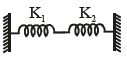
- 2View SolutionThe effective spring constant of two spring system as shown in figure will be
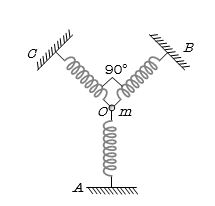
- 3A particle of mass $m$ is attached to three identical springs $A, B$ and $C$ each of force constant $ k$ a shown in figure. If the particle of mass $m$ is pushed slightly against the spring $A$ and released then the time period of oscillations isView Solution
- 4A particle executes a simple harmonic motion of time period $T$. Find the time taken by the particle to go directly from its mean position to half the amplitudeView Solution
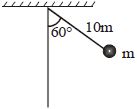
- 5View SolutionIf pendulum is released from given position find velocity of Bob when it reaches the lowest position
- 6A pendulum with time period of $1\, s$ is losing energy due to damping. At certain time its energy is $45\, J$. If after completing $15\,oscillations$ , its energy has become $15\, J$, its damping constant (in $s^{-1}$ ) isView Solution
- 7Four harmonic waves of equal frequencies and equal intensities $I_0$ have phase angles $0, \pi / 3,2 \pi / 3$ and $\pi$. When they are superposed, the intensity of the resulting wave is $nI _0$. The value of $n$ isView Solution
- 8At a given point of time the value of displacement of a simple harmonic oscillator is given as $y = A \cos \left(30^{\circ}\right)$. If amplitude is $40\,cm$ and kinetic energy at that time is $200\, J$, the value of force constant is $1.0 \times 10^{ x }\,Nm ^{-1}$. The value of $x$ is ......View Solution
- 9View SolutionA tunnel has been dug through the centre of the earth and a ball is released in it. It will reach the other end of the tunnel after
- 10A particle of mass $0.50 \mathrm{~kg}$ executes simple harmonic motion under force $\mathrm{F}=-50\left(\mathrm{Nm}^{-1}\right) \mathrm{x}$. The time period of oscillation is $\frac{x}{35} s$. The value of $x$ is . . . . .(Given $\pi=\frac{22}{7}$ )View Solution