MCQ
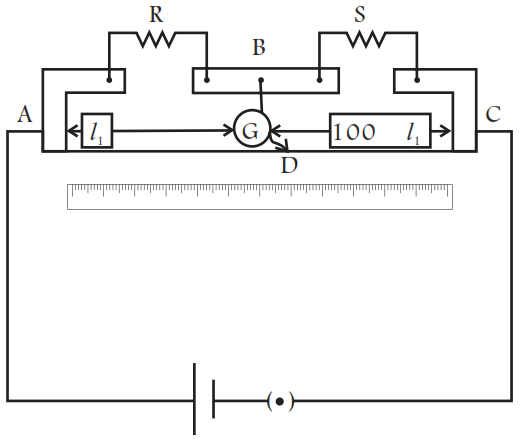
In a meter bridge the point D is a neutral point (Fig).

  • A
    The meter bridge can have no other neutral point for this set of resistances.
  • B
    When the jockey contacts a point on meter wire left of D, current flows to B from the wire.
  • C
    When the jockey contacts a point on the meter wire to the right of D, current flows from B to the wire through galvanometer.
  • D
    When R is increased, the neutral point shifts to left

Answer

  1. The meter bridge can have no other neutral point for this set of resistances.
  1. When the jockey contacts a point on the meter wire to the right of D, current flows from B to the wire through galvanometer.

Solution:

Key concept: Meter bridge: In case of meter bridge, the resistance wire AC is 100cm long. Varying the position of tapping point B, bridge is balanced. If in balanced position of bridge AB = l, BC = (100 - l) so that $\frac{\text{Q}}{\text{P}}=\frac{(100-\text{I})}{\text{I}}$. Also $\frac{\text{P}}{\text{Q}}=\frac{\text{R}}{\text{S}}>\text{S}=\frac{(100-\text{I})}{\text{I R}}$.

When there is no deflection in galvanometer there is no current across the galvanometer, then points B and D are at same potential. That point at which galvanometer shows no deflection is called null point, then potential at B and neutral point D are same. When the jockey contacts a point on the meter wire to the right of D, the potential drop across AD is more than potential drop across AB, which brings the potential of point D less than that of B, hence current flows from B to D in the galvanometer wire.
Need a full question paper?

Generate a complete, print-ready paper with questions like this in minutes — across 16+ boards, with answer keys.

Start Generating Free

Similar questions

Two concentric coils each of radius equal to 2π cm are placed at right angles to each other. 3 ampere and 4 ampere are the currents flowing in each coil respectively. The magnetic induction in   at the centre of the coils will be (

(a) 5 

(b) 7  

(c) 12  

(d)   

The resistance of a wire is   per metre. It is bend in the form of a circle of diameter 2 m. A wire of the same material is connected across its diameter. The total resistance across its diameter AB will be

(a)  

(b)  

(c) 0.88  

(d) 14π 

Two identical heaters rated 220 volt, 1000 watt are placed in series with each other across 220 volt lines. If resistance do not change with temperature, then the combined power is

(a) 1000 watt

(b) 2000 watt

(c) 500 watt

(d) 4000 watt

A straight wire carrying a current  runs along the axis of a circular current . Then the force of interaction between the two current carrying conductors is

(a)     

(b) Zero

(c)  

(d)  

What is the value of inductance L for which the current is a maximum in a series LCR circuit with $\text{C}=10\mu\text{F}$ and $\omega=1000_\text{s}^{-1}$?
NOR gate is the series combination of:

The resistance of a wire of uniform diameter d and length L is R. The  resistance of another wire of the same material but diameter 2d  and length 4L will be

(a) 2R

(b) R

(c) R/2

(d) R/4

A positive charge Q is uniformly distributed along a circular ring of radius R.A. small test charge q is placed at the centre of the ring Fig. Then:

If the cathode–anode potential difference in an X-ray tube be 105 V, then the maximum energy of X-ray photon can be

(a) 105 J  

(b) 105 MeV

(c) 10–1 MeV

(d) 105 KeV

Two resistors A and B have resistances RA and RB, respectively, and RA < RB. The resistivities of their materials are $\rho _{\text{A}}$ and $\rho_{\text{B}}.$
  1. $\rho _\text{A}>\rho _\text{B}$
  2. $\rho _\text{A}=\rho _\text{B}$
  3. $\rho _\text{A}<\rho _\text{B}$
  4. The information is not sufficient to find the relation between $\rho _\text{A}$ and $\rho _\text{B}.$
