MCQ
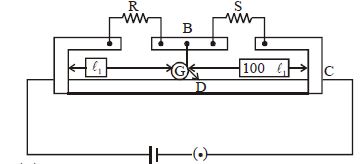
In a meter bridge the point $D$ is neutral point as shown in the figure.
  • A
    The meter bridge can have no other neutral point for this set of resistances
  • B
    When the jockey contacts a point on meter wire left of $D$, current flows to $B$ from the wire
  • When the jockey contacts a point on the meter wire to the right of $D$, current flows from $B$ to the wire through galvanometer
  • D
    When $R$ is increased, the neutral point shifts to left
Answer

Correct option: C.
When the jockey contacts a point on the meter wire to the right of $D$, current flows from $B$ to the wire through galvanometer
c

Need a full question paper?

Generate a complete, print-ready paper with questions like this in minutes — across 16+ boards, with answer keys.

Start Generating Free

Similar questions

Product of resistivity and conductivity of any conductor depends on:
In an $AC$ generator, a coil with $N$ turns, all of the same area $A$ and total resistance $R$, rotates with frequency $\omega$ in a magnetic field $B$. The maximum value of emf generated in the coil is
A proton moving with a constant velocity passes through a region of space without any change in its velocity. If $\overrightarrow E $ and $\overrightarrow B $ represent the electric and magnetic fields respectively, then this region of space may have
For a thermocouple, the temperature of inversion is that temperature at which thermo e.m.f. is
The third line of Balmer series of an ion equivalent to hydrogen atom has wavelength of 108.5 nm. The ground state energy of an electron of this ion will be
The electric potential $V(x, y, z)$ for a planar charge distribution is given by: 

$V\left( {x,y,z} \right) = \left\{ {\begin{array}{*{20}{c}}
{0\,\,\,\,\,\,\,\,\,\,\,\,\,\,\,\,\,\,\,\,\,\,\,\,\,\,\,\,\,\,\,\,\,\,\,for\,x\, < \, - d}\\
{ - {V_0}{{\left( {1 + \frac{x}{d}} \right)}^2}\,\,\,\,\,\,\,\,\,\,\,\,\,\,\,\,\,\,for\, - \,d\, \le x < 0}\\
{ - {V_0}\left( {1 + 2\frac{x}{d}} \right)\,\,\,\,\,\,\,\,\,\,\,for\,0\, \le x < d}\\
{ - 3{V_0}\,\,\,\,\,\,\,\,\,\,\,\,\,\,\,\,\,\,\,\,\,\,\,\,\,\,for\,x\, > \,d}
\end{array}} \right.$

where $-V_0$ is the potential at the origin and $d$ is a distance. Graph of electric field as a function of position is given as

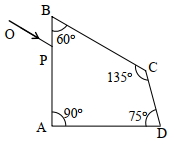
A ray $\mathrm{OP}$ of monochromatic light is incident on the face $\mathrm{AB}$ of prism $\mathrm{ABCD}$ near vertex $\mathrm{B}$ at an incident angle of $60^{\circ}$ (see figure). If the refractive index of the material of the prism is $\sqrt{3}$, which of the following is (are) correct? $Image$

$(A)$ The ray gets totally internally reflected at face $CD$

$(B)$ The ray comes out through face $\mathrm{AD}$

$(C)$ The angle between the incident ray and the emergent ray is $90^{\circ}$

$(D)$ The angle between the incident ray and the emergent ray is $120^{\circ}$

When a certain photosensitive surface is illuminated with monochromatic light of frequency $v$ , the stopping potential for the photo current is $-V_0/2.$ When the surface is illuminated by monochromatic light of frequency $v/2,$ the stopping potential is $-V_0.$ The threshold frequency for photoelectric emission is
Given below are two statements:

Statement $I:$ For diamagnetic substance $-1 \leq \chi < 0$, where $\chi$ is the magneticsusceptibility.

Statement $II:$ Diamagnetic substances when placed in an external magnetic field, tend to move from stronger to weaker part of the field.

In the light of the above statements, choose the correct answer from the options given below.

If the rotational velocity of dynamo armature is doubled, then induced emf will become: