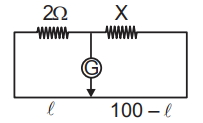
In a metre-bridge when a resistance in the left gap is $2\ \Omega$ and unknown resistance in the right gap, the balance length is found to be $40\ \mathrm{~cm}$. On shunting the unknown resistance with $2\ \Omega$, the balance length changes by :
JEE MAIN 2024, Diffcult


Download our appand get started for free
Experience the future of education. Simply download our apps or reach out to us for more information. Let's shape the future of learning together!No signup needed.*
Similar Questions
- 1A car has a fresh battery of $e.m.f$. $12\, V$ and internal resistance of $0.05\, \Omega$. If the starter motor draws a current of $90\, A$, the terminal voltage when the starter is on will be ............... $V$View Solution
- 2$A$ battery consists of a variable number $n$ of identical cells having internal resistance connected in series. The terminals of the battery are short circuited and the current $I$ measured. Which one of the graph below shows the relationship between $I$ and $n$?View Solution
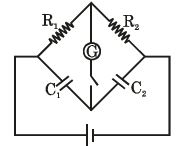
- 3View SolutionCircuit shown is in steady state, now when switch is closed, galvanometer shows no deflection, then correct relation is
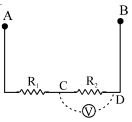
- 4Resistances $R_1$ and $R_2$ each $60\,\Omega$ are connected in series as shown in figure. The Potential difference between $A$ and $B$ is kept $120$ volt. Then what ............. $V$ will be the reading of voltmeter connected between the point $C$ and $D$ if resistance of voltmeter is $120\,\Omega .$View Solution
- 5You are given three bulbs of $25$, $40$ and $60\, watt$. Which of them has lowest resistanceView Solution
- 6A battery consists of a variable number '$n$' of identical cells having internal resistances connected in series. The terminals of battery are short circuited and the current $i$ is measured. Which of the graph below shows the relation ship between $i$ and $n$View Solution
- 7Two non-ideal identical batteries are connected in parallel. Consider the following statementsView Solution
$(i)$ The equivalent e.m.f. is smaller than either of the two $e.m.f.$ is
$(ii)$ The equivalent internal resistance is smaller than either of the two internal resistances
- 8View SolutionIn the circuit shown here, the readings of the ammeter and voltmeter are
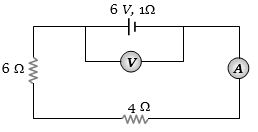
- 9When the current $i$ is flowing through a conductor, the drift velocity is $v$. If $2i$ current is flowed through the same metal but having double the area of cross-section, then the drift velocity will beView Solution
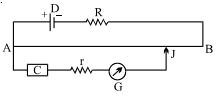
- 10In the given potentiometer circuit, the resistance of the potentiometer wire $AB$ is $R_0$. $C$ is a cell of internal resistance $r$. The galvanometer $G$ does not give zero deflection for any position of the jockey $J$. Which of the following cannot be a reason for this?View Solution