You are given three bulbs of $25$, $40$ and $60\, watt$. Which of them has lowest resistance
Medium
Download our app for free and get started
(c) Because $R \propto \frac{1}{P}$

Download our appand get started for free
Experience the future of education. Simply download our apps or reach out to us for more information. Let's shape the future of learning together!No signup needed.*
Similar Questions
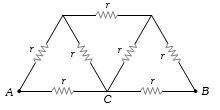
- 1In the circuit shown, the value of each resistance is $r$, then equivalent resistance of circuit between points $A$ and $B$ will beView Solution
- 2When $5\ V$ potential difference is applied across a wire of length $0.1\ m$, the drift speed of electrons is $2.5 \times 10^{-4}$ $ms^{-1}$ . If the electron density in the wire is $8 \times 10^{28}$ $m^{-3}$ the resistivity of the material is close toView Solution
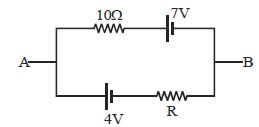
- 3In the following circuit if $V_A -V_B = 6\,V$ then the value of resistance $R$ (in $ohm$) is ............... $\Omega$View Solution
- 4Time taken by a $836\; W$ heater to heat $1\; litre$ of water from $10^{\circ} C$ to $40^{\circ} C$ isView Solution
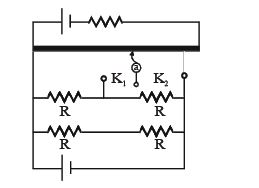
- 5In potentiometer experiment when $K_1$ is closed balance length is $100\,cm$. Then what will be balancing length when $K_2$ is closed ................ $\mathrm{cm}$View Solution
- 6Consider four conducting materials copper, tungsten, mercury and aluminium with resistivity $\rho_{ C }, \rho_{ T }, \rho_{ M }$ and $\rho_{ A }$ espectively Then:View Solution
- 7The figure shows a network of five resistances and two batteries The current through the $30\,V$ battery is ............... $A$View Solution
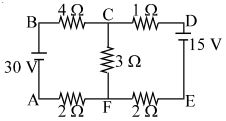
- 8In an experiment to find $emf$ of a cell using potentiometer, the length of null point for a cell of emf $1.5\,V$ is found to be $60\,cm$. If this cell is replaced by another cell of $emf\; E$. the length-of null point increases by $40\,cm$. The value of $E$ is $\frac{x}{10} V$. The value of $x$ is $............$View Solution
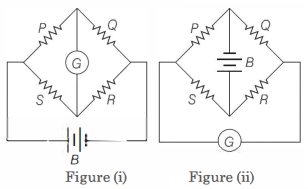
- 9Figure $(i)$ below shows a Wheatstone's bridge in which $P, Q, R$ and $S$ are fixed resistances, $G$ is a galvanometer and $B$ is a battery. For this particular case, the galvanometer shows zero deflection. Now, only the positions of $B$ and $G$ are interchanged, as shown in figure $(ii)$. The new deflection of the galvanometerView Solution
- 10Figure shows three similar lamp. $L_1,L_2$ and $L_3$ connected across a power supply. If the lamp $L_3$ fuses, how will the light emitted by $L_1$ and $L_2$ change ?View Solution