Question
In a photo-diode, 

Answer

  1. Photocurrent is proportional to incident light intensity.
Explanation:
In a photodiode, photocurrent is directly proportional to intensiy of incident light. More the incident light intensity, more will be the current produced.

Need a full question paper?

Generate a complete, print-ready paper with questions like this in minutes — across 16+ boards, with answer keys.
Start Generating Free

Similar questions

In Young’s double slit experiment the amplitudes of two sources are 3a and a respectively. The ratio of intensities of bright and dark fringes will be (a) 3 : 1   (b) 4 : 1(c) 2 : 1    (d)  9 : 1
       
Magnitude of magnetic field for a definite cross-section of a current carrying toroid is:
The work done in moving a unit positive test charge over a closed path in an electric field is _____________.
On passing $96500$ coulomb of charge through a solution $\mathrm{CuSO}_4$ the amount of copper liberated is
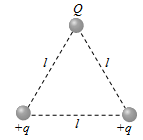
Three charges $Q(+q)$  and $(+q)$  are placed at the vertices of an equilateral triangle of side $l$ as shown in the figure. If the net electrostatic energy of the system is zero, then $Q$ is equal to
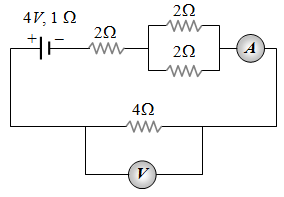
What is the equivalent resistance of the circuit
In order to pass 10% of main current through a moving coil galvanometer of 99 ohm, the resistance of the required shunt is(a) 9.9 Ω(b) 10 Ω(c) 11 Ω(d) 9 Ω
       
Which of the following statements is false?
Which of the following, the most suitable material for making permanent magnet is(a) Steel (b) Soft iron(c) Copper(d) Nickel
       
Assertion  :   Current is passed through a metallic wire, heating it red. When cold water is poured on half of its portion, then rest of the half portion become more hot.  
Reason    : Resistances decreases due to decrease in temperature and so current through wire increases.(a) If both assertion and reason are true and the reason is the correct explanation of the assertion.(b) If both assertion and reason are true but reason is not the correct explanation of the assertion.(c) If assertion is true but reason is false.(d) If the assertion and reason both are false.