MCQ
In a photo-diode, 
  • A
    Photocurrent is proportional to incident light intensity.
  • B
    Photocurrent is inversely proportional to incident light intensity.
  • C
    Photocurrent is independent of the incident light intensity.
  • D
    Incident light intensity is proportional to the photocurrent.
Answer

  1. Photocurrent is proportional to incident light intensity.

Explanation:

In a photodiode, photocurrent is directly proportional to intensiy of incident light. More the incident light intensity, more will be the current produced.

Need a full question paper?

Generate a complete, print-ready paper with questions like this in minutes — across 16+ boards, with answer keys.

Start Generating Free

Similar questions

A point charge is situated at an axial point of a small electric dipole at a large distance from it. The charge experiences a force F. If the distance of the charge is doubled, the force acting on the charge will become:
In an LCR circuit inductance is changed from L to $\frac{\text{L}}{2}.$ To keep the same resonance frequency, C should be changed to.

Assertion :  Newton’s rings are formed in the reflected system. When the space between the lens and the glass plate is filled with a liquid of refractive index greater than that of glass, the central spot of the pattern is dark.

Reason     : The reflection is Newton’s ring cases will be from a denser to a rarer medium and the two interfering rays are reflected under similar conditions.

(a) If both assertion and reason are true and the reason is the correct explanation of the assertion.

(b) If both assertion and reason are true but reason is not the correct explanation of the assertion.

(c) If assertion is true but reason is false.

(d) If the assertion and reason both are false.

A coil of inductance L is carrying a steady current i. What is the nature of its stored energy

(a)  Magnetic

(b)  Electrical

(c)  Both magnetic and electrical

(d)  Heat

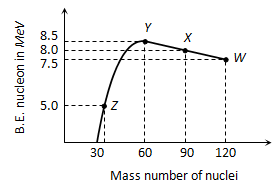
Binding energy per nucleon verses mass number curve for nuclei is shown in the figure. W, X, Y and Z are four nuclei indicated on the curve. The process that would release energy is

(a) Y   2Z

(b) W → X + Z

(c) W → 2Y

(d) X → Y + Z

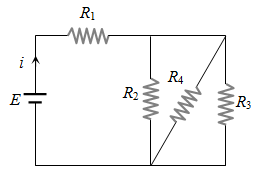
In the circuit given E = 6.0 V, R1 = 100 ohms, R2 = R3 = 50 ohms, R4 = 75 ohms. The equivalent resistance of the circuit, in ohms, is

(a) 11.875

(b) 26.31

(c) 118.75

(d) None of these

If L is the coherent length and c the velocity of light, the coherent time is:

How should people wearing spectacles work with a microscope

(a) They cannot use the microscope at all 

(b) They should keep on wearing their spectacles

(c) They should take off spectacles 

(d) (b) and (c) is both way 

A current carrying loop is placed in a uniform magnetic field. The torque acting on it does not depend upon:
What is the driving force in a working Electrical Circuit?