Question
In a plane electromagnetic wave, the electric field oscillates sinusoidally at a frequency of $2.0 \times 10^{10} Hz$ and amplitude $48 V m ^{-1}$.
(a) What is the wavelength of the wave?
(b) What is the amplitude of the oscillating magnetic field?
(c) Show that the average energy density of the E field equals the average energy density of the B field $\left[ c =3 \times 10^8 m s ^{-1}\right]$.
Answer

Given : $\quad v=2.0 \times 10^{10} Hz$
$E_0=48 V / m$
$\lambda=?$
$B _0=?$ and $c =3 \times 10^8 m / s$
(a) Wavelength, $\quad \lambda=\frac{c}{v}$
$=\frac{3 \times 10^8}{2 \times 10^{10}}=1.5 \times 10^{-2} m$
(b)$B_0=\frac{E_0}{c}$
On putting the values,
$B_0=\frac{48}{3 \times 10^8} T$
$B_0=16 \times 10^{-8} T=1.6 \times 10^{-7} T$
(c) Energy density in electric field $U_E=\frac{1}{2} \in_0 E^2$
Energy density in magnetic field $U_B=\frac{1}{2 \mu_0} B^2$
Energy density $\quad U _{ E }=\frac{1}{2} \in_0(c B)^2 \quad \because E =c B$
$U _{ E }=\frac{1}{2} \in_0 c^2 B^2=c^2\left(\frac{1}{2} \in_0 B^2\right)$
But $c=\frac{1}{\sqrt{\mu_0 \in_0}}$
$c^2=\frac{1}{\mu_0 \in_0}$
$\therefore \quad U _{ E }=\frac{1}{\mu_0 \in_0}\left(\frac{1}{2} \in_0 B^2\right)$
$=\frac{1}{2 \mu_0} B^2= U _{ B }$
$\therefore \quad U _{ E }= U _{ B }$
Hence the average energy density of the $\vec{E}$ field equals the averge energy density of the $\vec{B}$ field.

Need a full question paper?

Generate a complete, print-ready paper with questions like this in minutes — across 16+ boards, with answer keys.

Start Generating Free

Similar questions

Two fat astronauts each of mass 120kg are travelling in a closed spaceship moving at a speed of 15km/s in the outer space far removed from all other material objects. The total mass of the spaceship and its contents including the astronauts is 660kg. If the astronauts do slimming exercise and thereby reduce their masses to 90kg each, with what velocity will the spaceship move?
A metal rod is placed along the axis of a solenoid carrying a high-freqμency alternating current. It is found that the rod gets heated. Explain why the rod gets heated.
When a current/ flows through a coil, flux linked with it is $\phi=\text{LI},$ where L is a constant known as self inductance of the coil. Any change in current sets up an induced emf in the coil. Tims, self inductance of a coil is the induced emf set up in it when the current passing through it changes at the unit rate. It is a measure of the opposition to the growth or the decay of current flowing through the coil. Also, value of self inductance depends on the number of turns in the solenoid, its area of cross-section and the relative permeability of its core material.

  1. The inductance in a coil plays the same role as:
  1. Inertia in mechanics.
  2. Energy in mechanics.
  3. Momentum in mechanics.
  4. Force in mechanics.
  1. A current of 2.5A flows through a coil of inductance 5H. The magnetic flux linked with the coil is:
  1. 0.5Wb
  2. 12.5Wb
  3. Zero
  4. 2Wb
  1. The inductance L of a solenoid depends upon its radius R as:
  1. $\text{L}\propto\text{R}$

  2. $\text{L}\propto\frac{1}{\text{R}}$

  3. $\text{L}\propto\text{R}^2$

  4. $\text{L}\propto\text{R}^3$

  1. The unit of self-inductance is:
  1. Weber ampere
  2. Weber-1 ampere
  3. Ohm second
  4. Farad
  1. The induced e.m.f. in a coil of 10 henry inductance in which current varies from 9A to 4A in 0.2 second is:
  1. 200V
  2. 250V
  3. 300V
  4. 500V 
No part of India is situated on the equator. Is it possible to have a geostationary satellite which always remains over New Delhi?
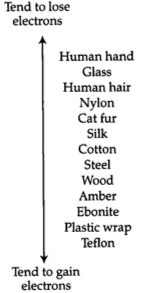
The triboelectric series is a list that ranks materials according to their tendency to gain or lose electrons. The process of electron transfer as a result of two objects coming into contact with one another and then separating is called triboelectric charging. During such an interaction, one of the two objects will always gain electrons (becoming negatively charged) and the other object will lose electrons (becoming positively charged). The relative position of the two objects on the triboelectric series will define which object gains electrons and which object loses electrons.
In triboelectric series, materials are ranked from high to low in terms of the tendency for the material to lose electron. If an object high up on this list (Glass, for example) is rubbed with an object low down on the list (Teflon, for example), the glass will lose electrons to the teflon. The glass will, in this case, become positively charged and the teflon will become negatively charged. Materials in the middle of the list (steel and wood, for example) are items those do not have a strong tendency to give up or accept electrons.
Image
(i) Materials in the upper position have ________ tendency to become positively charged
(a) no (b) medium (c) high (d) low
(ii) Name two materials which do not have a strong tendency to give up or accept electrons.
(a) Steel, wood (b) Plastic wrap, Teflon (c) Ebonite, Nylon (d) Nylon, cat fur
(iii) if human hair is rubbed with amber, how those will be charged?
(a) Hair will be negatively charged, Amber will be positively charged.
(b) Both positive
(c) Hair will be positively charged, Amber will be negatively charged.
(d) Both negative
(iv) Triboelectric charging is the process of electron transfer between two objects
(a) By contact (b) Without contact (c) By anyone of these (d) By none of these

OR

The object which loses electron becomes ________ charged and the object gains electron becomes ________ charged.
(a) positively, positively
(b) negatively, positively
(c) negatively, negatively
(d) positively, negatively
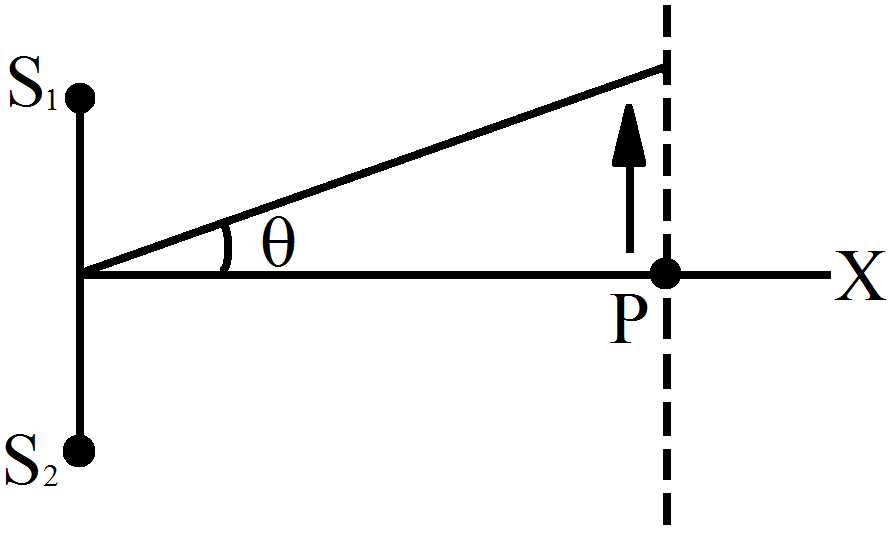
Two speakers S1 and S2, driven by the same amplifier, are placed at y = 1.0m and y = -1.0m figure, The speakers vibrate in phase at 600Hz. A man stands at a point on the X-axis at a very large distance from the origin and starts moving parallel to the Y-axis. The speed of sound in air is 330m/s.

  1. At what angle $\theta$ will the intensity of sound drop to a minimum for the first time?
  2. At what angle will he hear a maximum of sound intensity for the first time?
  3. If he continues to walk along the line, how many more maxima can he hear?

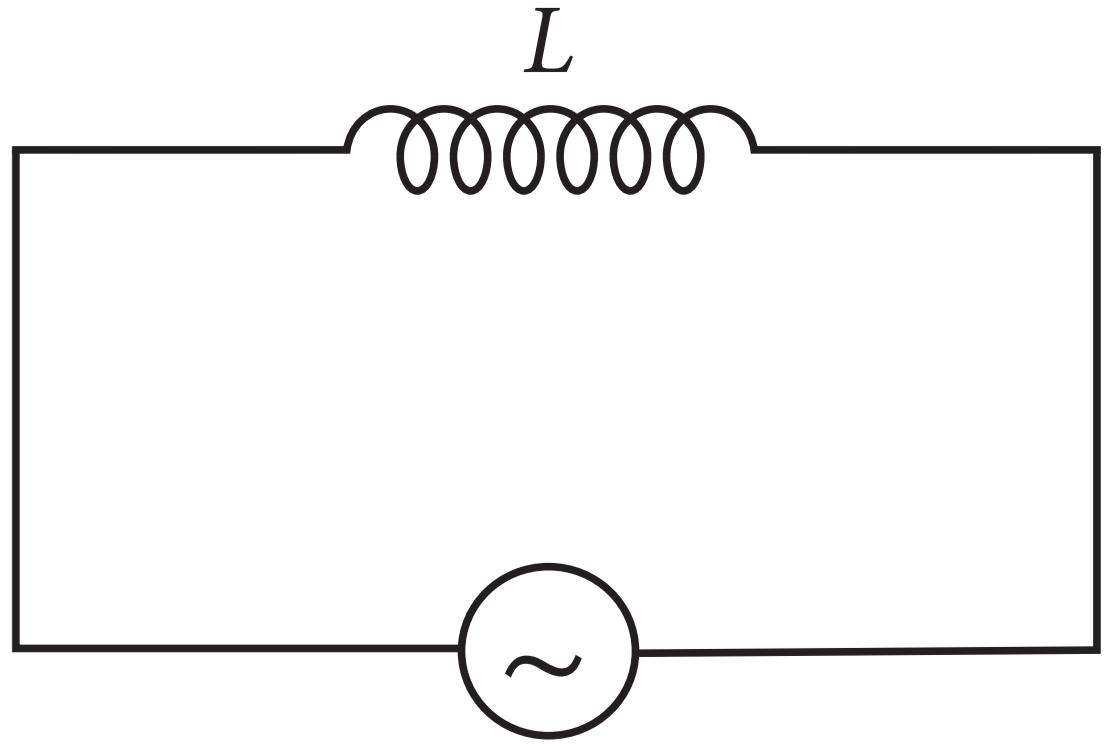
Let a source of alternating e.m.f. $\text{E} = \text{E}_\circ\sin\omega\text{t}$ be connected to a circuit containing a pure inductance L. If I is the value of instantaneous current in the circuit, then $\text{I}=\text{I}_\circ\sin\Big(\omega\text{t}-\frac{\pi}{2}\Big).$ The inductive reactance limits the current in a purely inductive circuit and is given by $\text{X}_\text{L}= \text{W}_\text{L}.$

  1. A 100 hertz a.c. is flowing in a 14mH coil. The reactance is:
  1. $15\Omega$
  2. $7.7\Omega$
  3. $8.8\Omega$
  4. $10\Omega$
  1. In a pure inductive circuit, resistance to the flow of current is offered by:
  1. Resistor
  2. Inductor
  3. Capacitor
  4. Resistor and inductor
  1. In a inductive circuit, by what value of phase angle does alternating current lags behind e.m.f.?
  1. 45º
  2. 90º
  3. 120º
  4. 75º
  1. How much inductance should be connected to 200V, 50Hz a.c. supply so that a maximum current of 0.9A flows through it?
  1. 5H
  2. 1H
  3. 10H
  4. 4.5H
  1. The maximum value of current when inductance of 2H is connected to 150V, 50Hz supply is:
  1. 0.337A
  2. 0.721A
  3. 1.521A
  4. 2.522A
Explain the use of chock coil.
Two q charges of the same nature are located at a distance d from each other, the third charge of value Q Coulomb is at the mid-point of the line joining them. For what value of Q will the system be in equilibrium?
Photoelectric effect is the phenomenon of emission of electrons from a metal surface, when radiations of suitable frequency fall on them. The emitted electrons are called photoelectrons and the current so produced is called photoelectric current.
  1. With the increase of intensity of incident radiations on photoelectrons emitted by a photo tube, the number of photoelectrons emitted per unit time is:
  1. Increases.
  2. Decreases.
  3. Remains same.
  4. None of these.
  1. It is observed that photoelectron emission stops at a certain time t after the light source is switched on. The stopping potential (V) can be represented as:
  1. 2(KEmax/e)
  2. (KEmax/e)
  3. (KEmax/3e)
  4. (KEmax/2e)
  1. A point source of light of power 3.2 × 10-3 W emits monoenergetic photons of energy 5.0eV and work function 3.0eV. The efficiency of photoelectron emission is 1 for every 106 ncident photons. Assume that photoelectrons are instantaneously swept away after emission. The maximum kinetic energy of photon is:
  1. 4eV
  2. 5eV
  3. 2eV
  4. Zero
  1. Which of the following device is the application of Photoelectric effect?
  1. Light emitting diode.
  2. Diode.
  3. Photocell.
  4. Transistor.
  1. If the frequency of incident light falling on a photosensitive metal is doubled, the kinetic energy of the emitted photoelectron is:
  1. Unchanged.
  2. Halved.
  3. Doubled.
  4. More than twice its initial value.