MCQ
In a purely inductive circuit, the current:
- Ais in phase with the voltage
- Bis out of phase with the voltage
- Cleads the voltage by $\frac{\pi}{2}$
- Dlags behind the voltage by $\frac{\pi}{2}$
Explanation:
In a purely inductive circuit (an AC circuit containing inductance only) the current lags behind the voltage by $\frac{\pi}{2}$
Generate a complete, print-ready paper with questions like this in minutes — across 16+ boards, with answer keys.
Lamps used for household lighting are connected in
|
(a) Series |
(b) Parallel |
(c) Mixed circuit |
(d) None of the above |
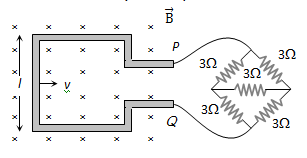
A square metallic wire loop of side 0.1 m and resistance of 1W is moved with a constant velocity in a magnetic field of 2 wb/m2 as shown in figure. The magnetic field is perpendicular to the plane of the loop, loop is connected to a network of resistances. What should be the velocity of loop so as to have a steady current of 1mA in loop
|
(a) 1 cm/sec |
(b) 2 cm/sec |
(c) 3 cm/sec |
(d) 4 cm/sec |
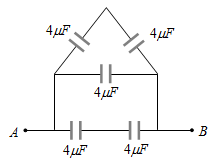
Equivalent capacitance between A and B is
|
(a) 8 μC |
(b) 6 μF |
(c) 26 μF |
(d) 10/3 μF |
Nucleus produced due to a-decay of the nucleus  is
is
|
(a) |
(b) |
(c) |
(d) |
The time period of a vibration magnetometer is T0. Its magnet is replaced by another magnet whose moment of inertia is 3 times and magnetic moment is 1/3 of the initial magnet. The time period now will be
|
(a) 3T0 |
(b) T0 |
(c) |
(d) T0/3 |


