MCQ
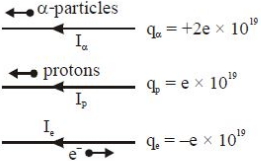
In a region $10^{19}$ $\alpha -$ particels and $10^{19}$ protons per second move to the left, while $10^{19}$ electrons moves to the right per second. The current is
  • A
    $3.2\,A$ towards left
  • B
    $3.2\,A$ towards right
  • $6.4\,A$ towards left
  • D
    $6.4\,A$ towards right

Answer

Correct option: C.
$6.4\,A$ towards left
c
Current due to protons and $\alpha$ -particles is towards left and as ${e^ - }$ have $-$ ive charge, so current due to electrons is also towards left

$\therefore $ total current $\mathrm{I}=(2 \mathrm{e}+\mathrm{e}+\mathrm{e}) \times 10^{19}$

${=4 \times 1.6 \times 10^{-19} \times 10^{19}} $

${=6.4 \mathrm{\,A}}$

Need a full question paper?

Generate a complete, print-ready paper with questions like this in minutes — across 16+ boards, with answer keys.

Start Generating Free

Similar questions

A plane electromagnetic wave having a frequency $n = 23.9\, GHz$ propagates along the positive $z-$ direction in free space. The peak value of the electric field is $60\, V/m$. Which among the following is the acceptable magnetic field component in the electromagnetic wave?
The energy of a hydrogen atom in its ground state is -13.6eV. The energy of the level corresponding to the quantum number n = 2 (first excited state) in the hydrogen atom is
A capacitor of capacitance $50 \; pF$ is charged by $100 \; V$ source. It is then connected to another uncharged identical capacitor. Electrostatic energy loss in the process is $\dots \; nJ$.
Two identical thin metal plates has charge $q _{1}$ and $q _{2}$ respectively such that $q _{1}> q _{2}$. The plates were brought close to each other to form a parallel plate capacitor of capacitance $C$. The potential difference between them is.
Voltmeter reads potential difference across the terminals of an old battery as $1.2\,volt$ , while a potentiometer reads $1.4\,volt$ . The internal resistance of battery is $40\,\Omega $ , then voltmeter resistance is .............. $\Omega$
Light of wavelength $1824 Å$, incident on the surface of a metal, produces photo-electrons with maximum energy $5.3 eV.$ When light of wavelength $1216 Å$ is used, the maximum energy of photoelectrons is $8.7 eV$. The work function of the metal surface is .............. $eV$
Two straight parallel wires, both carrying $10$ $ampere$ in the same direction attract each other with a force of $1 \times {10^{ - 3}}\,N$. If both currents are doubled, the force of attraction will be
Electronic configuration of germanium is $2, 8, 18$ and $4$. To make it extrinsic semiconductor small quantity of antimony is added
Consider the following two statements A and B and identify the correct choice given in the answers
(A) Duddells thermo-galvanometer is suitable to measure direct current only
(B) Thermopile can measure temperature differences of the order of $10^{-3}{ }^{\circ} \mathrm{C}$
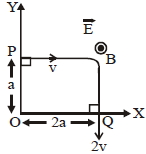
A charged particle of mass $\mathrm{m}$ and charge $q$ moving under the influence of uniform electric field $E\hat{i }$ and a uniform magnetic field $B\hat{k}$ follows a trajectory from point $\mathrm{P}$ to $\mathrm{Q}$ as shown in figure. The velocities at $P$ and $Q$ are respectively, $v\hat i$ and $-2 v \hat j$. Then which of the following statements $(\mathrm{A}, \mathrm{B}, \mathrm{C}, \mathrm{D})$ are the correct $?$ (Trajectory shown is schematic and not to scale)

$(A)$ $\mathrm{E}=\frac{3}{4}\left(\frac{\mathrm{mv}^{2}}{\mathrm{qa}}\right)$

$(B)$ Rate of work done by the electric field at $\mathrm{P}$ is $\frac{3}{4}\left(\frac{\mathrm{mv}^{3}}{\mathrm{a}}\right)$

$(C)$ Rate of work done by both the fields at $\mathrm{Q}$ is zero

$(D)$ The difference between the magnitude of angular momentum of the particle at $\mathrm{P}$ and $Q$ is $2 mav$.