MCQ
In a region of constant potential:
- AThe electric field is uniform.
- BThe electric field is zero.
- CThere can be no charge inside the region.
- DThe electric field shall necessarily change if a charge is placed outside the region.
We know, the electric field intensity E and electric potential V are dV related as $\text{E}=-\frac{\text{dV}}{\text{dr}}$
or we can write $|\text{E}|=-\frac{\Delta\text{V}}{\Delta\text{r}}$
The electric field intensity E and electric potential V are related as E = 0 and for V = constant, $\frac{\text{dV}}{\text{dr}}=0$ this imply that electric field intensity E = 0.
If some charge is present inside the region then electric field cannot be zero at that region, for this V = constant is not valid.
Generate a complete, print-ready paper with questions like this in minutes — across 16+ boards, with answer keys.
Watt-hour meter measures
|
(a) Electric energy |
(b) Current |
(c) Voltage |
(d) Power |
Which of the following is not the property of a cathode ray
|
(a) It casts shadow |
(b) It produces heating effect |
|
(c) It produces flurosence |
(d) It does not deflect in electric field |
The mutual characteristic curves of a triode are as shown in figure. The cut off voltage for the triode is
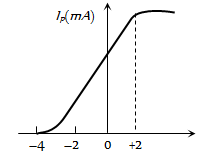
| (a) 0 V | (b) 2 V | (c) – 4 V | (d) 6 V |
A diverging beam of light from a point source S having divergence angle a, falls symmetrically on a glass slab as shown. The angles of incidence of the two extreme rays are equal. If the thickness of the glass slab is t and the refractive index n, then the divergence angle of the emergent beam is
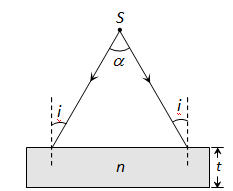
|
(a) Zero |
(b) α |
(c) |
(d) 2 |
A narrow electron beam passes undeviated through an electric field E = 3  and an overlapping magnetic field B = 2
  . If electric field and magnetic field are mutually perpendicular. The speed of the electrons is
|
(a) 60 m/s |
(b) 10.3 |
(c) 1.5 |
(d) 0.67 |
A condenser has a capacity 2μF and is charged to a voltage of 50 V. The energy stored is
|
(a) 25 × 105 Joule |
(b) 25 Joule |
(c) 25 × 10 erg |
(d) 25 × 103 erg |


