Question
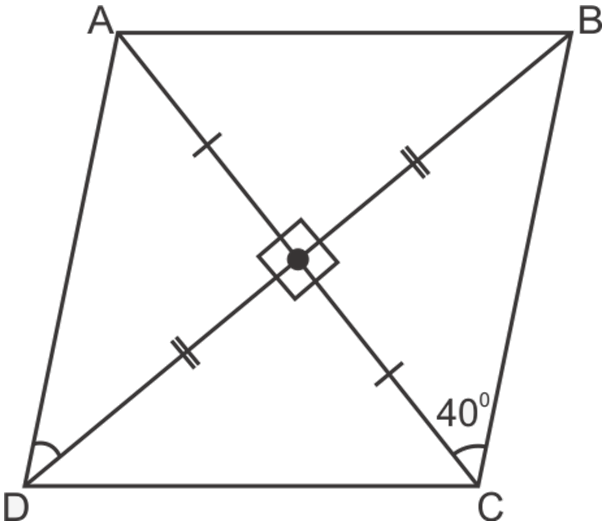
In a rhombus ABCD, if $\angle\text{ACB}=40^\circ,$ then $\angle\text{ADB}=$

Need a full question paper?

Generate a complete, print-ready paper with questions like this in minutes — across 16+ boards, with answer keys.
Start Generating Free

Similar questions

Three statements are given below:
  1. In a Rectangle ABCD, the diagonals AC bisects $\angle\text{A}$ as well as $\angle\text{C}.$
  2. In a Square ABCD, the diagonals AC bisects $\angle\text{A}$ as well as $\angle\text{C}.$
  3. In rhombus ABCD, the diagonals AC bisects $\angle\text{A}$ as well as $\angle\text{C}.$
Which is True?
    In a sphere the number of faces is:
    Which of the following is a true statment?
    1. $\pi$ and $\frac{22}{7}$ are both rationals.
    2. $\pi$ and $\frac{22}{7}$ are both irrationals
    3. $\pi$ is rational and $\frac{22}{7}$ is irrational.
    4. $\pi$ is irrational and $\frac{22}{7}$ is rational.
    How many lead shots, each $0.3\ cm$ in diameter, can be made from a cuboid of dimensions $9\ cm \times 11\ cm \times 12\ cm$?
    Given​​ $\angle\text{POR}=3\text{x}$ and​​ $\angle\text{QOR}=2\text{x}+10^\circ.$ If ​​$\angle\text{POQ}$ is a straight line, then the value of x is:
    The mean of the marks scored by 50 students was found to be 39. Later on it was discovered that a score of 43 was misread as 23. The correct mean is:
    The area of a quadrilateral whose diagonals measure $48m$ and $32m$ respectively and bisect each other at right angles is:
    The cost of turfing a triangular field at the rate of $Rs. 45$ per $100m^2$ is $Rs. 900.$ If the double the base of the triangle is $5$ times its height, then its height is:
    Directions: In the following questions, the Assertions (A) and Reason(s) (R) have been put forward. Read both the statements carefully and choose the correct alternative from the following:
    Assertion: If two irrational number whose quotient is a rational number.
    Reason: If two irrational number whose product is irrational number.
    The product $(a + b)(a - b)(a^2 - ab + b^2)(a^2 + ab + b^2)$ is equal to: