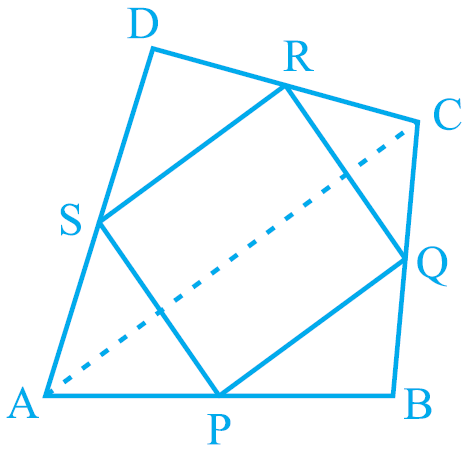
The Quadrilateral forms by joining the mid-points of the sides of a Quadrilateral PQRS, taken in order, is a Rhombus if:
Question types
Quadrilaterals question types
358 questions across 8 question groups — pick any mix to generate a MATHS paper with step-by-step answer keys.
358
Questions
8
Question groups
5
Question types
01
M.C.Q
243 Q→02Assertion (A) & Reason (B) MCQ
57 Q→03True False[1 Marks ]
6 Q→04Fill In The Blanks[1 Marks ]
11 Q→052 Marks Questions
7 Q→063 Marks Question
11 Q→075 Marks Questions
15 Q→08Case study (4 Marks)
8 Q→Sample Questions
Quadrilaterals questions
One sample from each question group in this chapter. Select any group above to see the full set with answer keys.
View full solution →
Two parallelograms stand on equal bases and between the same parallels. The ratio of their areas is:
In which of the following figures are the diagonals equal?
If $\angle\text{A},\ \angle\text{B},\ \angle\text{C}$ and $\angle\text{D}$ of a quadrilateral ABCD, taken in order, are in the ratio 3 : 7 : 6 : 4 then ABCD is a:
View full solution →If an angle of a parallelogram is two-third of its adjacent angle, the smallest angle of the parallelogram is:
Directions: In the following questions, the Assertions (A) and Reason(s) (R) have been put forward. Read both the statements carefully and choose the correct alternative from the following:
Assertion: A parallelogram consists of two congruent triangles.
Reason: Diagonal of a parallelogram divides it into two congruent triangles.
Assertion: A parallelogram consists of two congruent triangles.
Reason: Diagonal of a parallelogram divides it into two congruent triangles.
- Both assertion and reason are true and reason is the correct enatixplaon of assertion.
- Both assertion and reason are true but reason is not the correct explanation of assertion.
- Assertion is true but reason is false.
- Assertion is false but reason is true.
Directions: In the following questions, the Assertions (A) and Reason(s) (R) have been put forward. Read both the statements carefully and choose the correct alternative from the following:
Assertion: A parallelogram consists of two congruent triangles.
Reason: Diagonal of a parallelogram divides it into two congruent triangles.
Assertion: A parallelogram consists of two congruent triangles.
Reason: Diagonal of a parallelogram divides it into two congruent triangles.
- Both Assertion and Reason are correct and Reason is the correct explanation for Assertion.
- Both Assertion and Reason are correct and Reason is not the correct explanation for Assertion.
- Assertion is true but the reason is false.
- Both assertion and reason are false.
Directions: In the following questions, the Assertions (A) and Reason(s) (R) have been put forward. Read both the statements carefully and choose the correct alternative from the following:
Assertion: ABCD is a square. AC and BD intersect at O. The measure of $\angle\text{ABC}=900.$
Reason: Diagonals of a square bisect each other at right angles.
View full solution →Assertion: ABCD is a square. AC and BD intersect at O. The measure of $\angle\text{ABC}=900.$
Reason: Diagonals of a square bisect each other at right angles.
- Both Assertion and Reason are correct and Reason is the correct explanation for Assertion.
- Both Assertion and Reason are correct and Reason is not the correct explanation for Assertion.
- Assertion is true but the reason is false.
- Both assertion and reason are false.
Directions: In the following questions, the Assertions (A) and Reason(s) (R) have been put forward. Read both the statements carefully and choose the correct alternative from the following:
Assertion: A rectangle is 12cm wide, and 5cm tall, 13cm is the length of a diagonal.
Reason: A rectangle is 12cm wide, and 5cm tall, 13cm is the length of a diagonal.
Assertion: A rectangle is 12cm wide, and 5cm tall, 13cm is the length of a diagonal.
Reason: A rectangle is 12cm wide, and 5cm tall, 13cm is the length of a diagonal.
- Both Assertion and Reason are correct and Reason is the correct explanation for Assertion.
- Both Assertion and Reason are correct and Reason is not the correct explanation for Assertion.
- Assertion is true but the reason is false.
- Both assertion and reason are false.
Directions: In the following questions, the Assertions (A) and Reason(s) (R) have been put forward. Read both the statements carefully and choose the correct alternative from the following:
Assertion: Every square is a rectangle.
Reason: Because it is a quadrilateral with all four angles right angles.
Assertion: Every square is a rectangle.
Reason: Because it is a quadrilateral with all four angles right angles.
- Both Assertion and Reason are correct and Reason is the correct explanation for Assertion.
- Both Assertion and Reason are correct and Reason is not the correct explanation for Assertion.
- Assertion is true but the reason is false.
- Both assertion and reason are false.
If three sides of a quadrilateral are equal, it is a parallelogram.
In a parallelogram, the diagonals bisect each other.
In a parallelogram, the diagonals are equal.
In any quadrilateral, if a pair of opposite sides is equal, it is a parallelogram.
In a parallelogram, the diagonals intersect each other at right angles.
If both pairs of opposite sides of a quadrilateral are equal, then it is necessarily a _________. (rectangle, parallelogram, rhombus).
If one pair of opposite sides are equal and parallel, then the figure is _____________. (parallelogram, rectangle, trapezium).
The figure formed by joining the mid-points of consecutive sides of a quadrilateral is ____________.
If in a quadrilateral only one pair of opposite sides are parallel, the quadrilateral is _____________. (square, rectangle, trapezium).
The triangle formed by joining the mid-points of the sides of a right triangle is ____________.
ABCD is a rhombus show that diagonal AC bisects $\angle $A as well as $\angle $C and diagonal BD bisects $\angle $B as well as $\angle $D
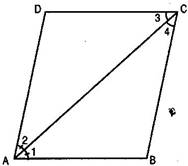
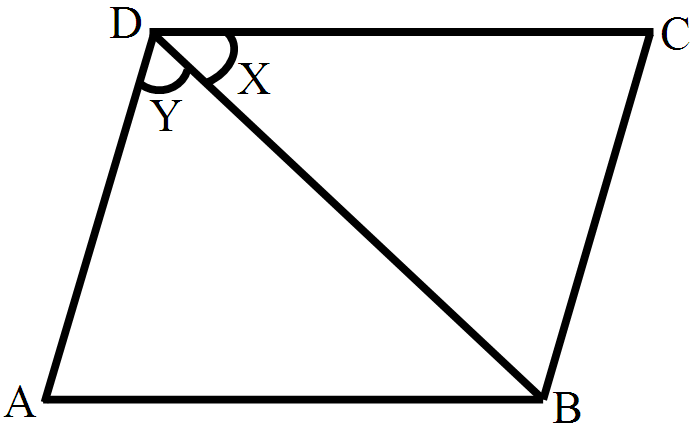
View full solution →Diagonal AC of a parallelogram ABCD bisects $\angle$A (See figure). Show that:
View full solution →- It bisects $\angle$C also.
- ABCD is a rhombus.
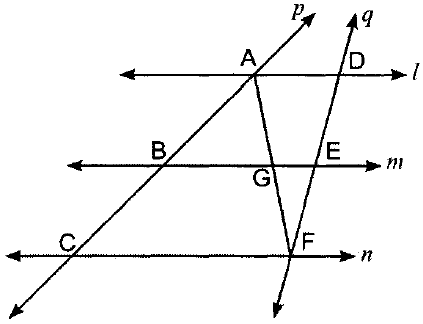
l, m and n are three parallel lines intersected by transversal p and q such that l, m and n cut-off equal intercepts AB and BC on p Show that l, m and n cut-off equal intercepts DE and EF on q also.
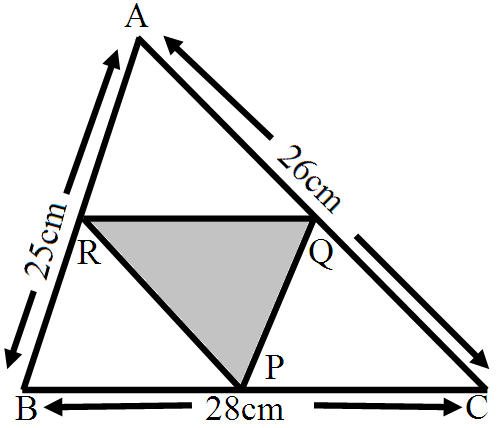
In $\triangle ABC$, D, E and F are respectively the mid-points of sides AB, BC and CA. Show that $\triangle ABC$ is divided into four congruent triangles by joining D, E and F.
View full solution →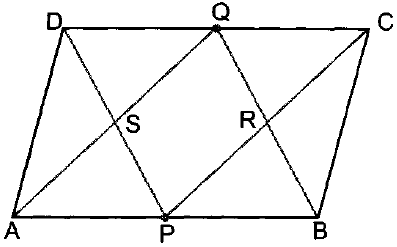
If the diagonals of a quadrilateral bisect each other, then it is a parallelogram.
If in a quadrilateral, each pair of opposite angles is equal, then it is a parallelogram.
Show that the line segments joining the mid-points of opposite sides of a quadrilateral bisect each other.
In a parallelogram ABCD, E and F are the mid-points of sides AB and CD respectively. Show that the line segments AF and EC trisect the diagonal BD.
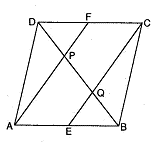
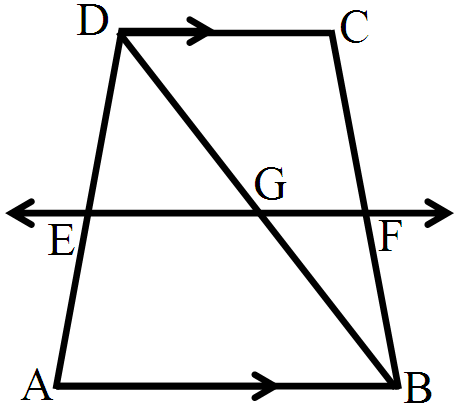
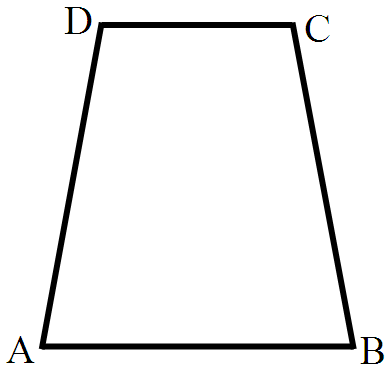
ABCD is a trapezium in which AB || DC, BD is a diagonal and E is the mid-point of AD. A line is drawn through E parallel to AB intersecting BC at F. Show that F is the mid-point of BC.
The line segment joining the mid-points of two sides of a triangle is parallel to the third side.
If each pair of opposite sides of a quadrilateral is equal, then it is a parallelogram.
In a parallelogram, opposite sides are equal.
A diagonal of a parallelogram divides it into two congruent triangles.
$\text{ABC}$ is a triangle right angled at $C.$ A line through the mid$-$point $M$ of hypotenuse $AB $ and parallels to $BC$ intersects $AC$ at $D$ Show that :
View full solution →- $D$ is the mid$-$point of $AC$
- $MD \perp AC$
- $CM = MA = \frac{1}{2} AB$
Read the Source/ Text given below and answer any four questions:
Chocolate is in the form of a quadrilateral with sides $6\ cm$ and $10\ cm, 5\ cm$ and$ 5\ cm ($as shown in the figure$)$ is cut into two parts on one of its diagonal by a lady. Part-I is given to her maid and part II is equally divided among a driver and gardener.
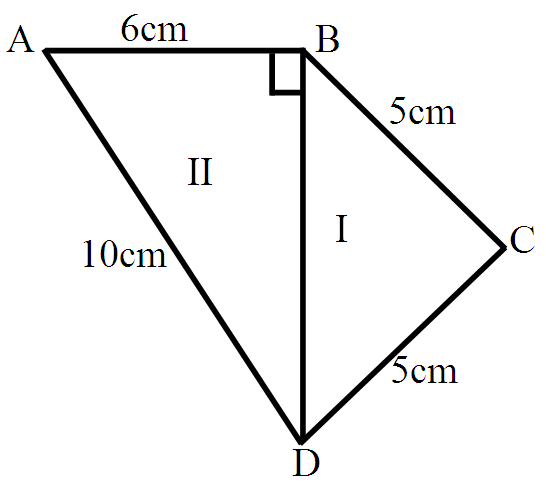
View full solution →Chocolate is in the form of a quadrilateral with sides $6\ cm$ and $10\ cm, 5\ cm$ and$ 5\ cm ($as shown in the figure$)$ is cut into two parts on one of its diagonal by a lady. Part-I is given to her maid and part II is equally divided among a driver and gardener.
- Length of $BD:$
- $9\ cm$
- $8\ cm$
- $7\ cm$
- $6\ cm$
- Area of $\triangle\text{ABC}:$
- $24\ cm^2$
- $12\ cm^2$
- $42\ cm^2$
- $21\ cm^2$
- The sum of all the angles of a quadrilateral is equal to:
- $180^\circ$
- $270^\circ$
- $360^\circ$
- $90^\circ$
- A diagonal of a parallelogram divides it into two congruent:
- Square.
- Parallelogram.
- Triangles.
- Rectangle.
- Each angle of the rectangle is:
- More than $90^\circ$
- Less than $90^\circ$
- Equal to $90^\circ$
- Equal to $45^\circ$

Generate a Quadrilaterals paper free
Pick question groups from the list above, set marks and difficulty, and export a branded PDF with step-by-step answer keys. First 3 chapters free — no signup.