Question
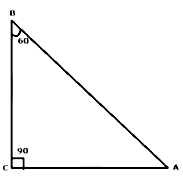
In a right $\triangle ABC$, right angled at $C$, if $\angle B = 60^\circ $ and $AB = 15$ units, find the remaining angles and sides.
Answer

Image
$\angle B=60^{\circ}$
$ \angle C=90^{\circ} \ldots($Since $\triangle  A B C$ is right angled at $C)$
$ \angle A+\angle B+\angle C=180^{\circ}$
$ \angle A+60^{\circ}+90^{\circ}=180^{\circ}$
$ \angle A=180^{\circ}-150^{\circ}$
$ \angle A=30^{\circ}$
Now,
$\sin 60^{\circ}=\frac{A C}{A B}$
$ A C=\sin 60^{\circ} \times A B$
$ A C=\frac{\sqrt{3}}{2} \times 15$
$ A C=\frac{15 \sqrt{3}}{2}$ units 
Also,
$\cos 60^{\circ}=\frac{ BC }{ AB }$
$ BC =\cos 60^{\circ} \times AB$
$ BC =\frac{1}{2} \times 15$
$ BC =7.5$ units.

Need a full question paper?

Generate a complete, print-ready paper with questions like this in minutes — across 16+ boards, with answer keys.

Start Generating Free

Similar questions

Draw the graph of the lines represented by the equations $5y = 3x + 1$ and $y = 2x + 3$ on the same graph. Find the coordinates of the point where they intersect.
The medians of a $\triangle ABC$ intersect each other at point $G$. If one of its medians is $AD$,prove that:$(i)$ Area $( \triangle ABD ) = 3 \times$ Area $( \triangle BGD );(ii)$ Area $( \triangle ACD ) = 3 \times$ Area $( \triangle CGD )(iii)$ Area $( \triangle BGC ) = \frac{1}{3} \times$ Area $( \triangle ABC ).$
Solve the following equations graphically $:\ x + 4y + 9 = 0 , 3y = 5x - 1$
Prove that the figure obtained by joining the mid-points of the adjacent sides of a rectangle is a rhombus.
Simplify by rationalising the denominator in the following.$\frac{5}{\sqrt{7}-\sqrt{2}}$
A town has 15625 inhabitants. If the population of this town increases at the rate of 4% per annum, find the number of inhabitants of the town at the end of 3 years.
A circle of the largest area is cut from a rectangular piece of cardboard with dimensions $55 \ cm$ and $42 \ cm$. Find the ratio between the area of the circle cut and the area of the remaining card$-$board.
$E, F, G,$ and $H$ are the midpoints of the sides of a parallelogram $\text{ABCD}$.Show that the area of quadrilateral $\text{EFGH}$ is half of the area of parallelogram $\text{ABCD}.$
$A$ and $B$ together can complete a piece of work in $6$ days. $A$ can do it alone in $10$ days. Find the number of days in which $B$ alone can do the work.
If $x = 1 + \log 2 - \log 5, y = 2 \log3$ and $z = \log a - \log 5;$ find the value ofaif $x + y = 2z.$