MCQ
In a semiconductor:
  • A
    There are no free electrons at 0K.
  • B
    The number of free electrons is less than that in a conductor.
  • C
    The number of free electrons increases with temperature.
  • All of the above.

Answer

Correct option: D.
All of the above.
Explanation:
In semiconductors, the valence band is full at 0K, but the conduction band is empty. So, no free electron is available for conduction at 0K.
As the temperature increases, covalent bonds that provide free charge carriers for conduction in a semiconductor break.
As the conduction band in metals is already partially filled at 0K, many free electrons below the Fermi level acquire energy from an external source or temperature, jump to the conduction band and start behaving like free electrons. Hence, metals contain more free electrons than semiconductors.

Need a full question paper?

Generate a complete, print-ready paper with questions like this in minutes — across 16+ boards, with answer keys.
Start Generating Free

Similar questions

There is a current of 20 amperes in a copper wire of $10^{-6}$ square metre area of cross-section. If the number of free electrons per cubic metre is $10^{29}$, then the drift velocity is
Which of the following diagrams represents the variation of electric field vector with time for a circulatory polarized light ?
In $\text{LCR}$ series $AC$ circuit.
The pointer of a dead-beat galvanometer gives a steady deflection because
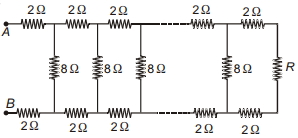
Consider the ladder network shown in figure. What should be the value of resistance $R$, so that effective resistance between $A$ and $B$ becomes independent of number of elements in the combination is ............. $\Omega$
In a transistor the base is very lightly doped as compared to the emitter because by doing so
The electrostatic energy of $Z$ protons uniformly distributed throughout a spherical nucleus of radius $R$ is given by

$E=\frac{3}{5} \frac{Z(Z-1) e^2}{4 \pi \varepsilon_0 R}$

The measured masses of the neutron, ${ }_1^1 \mathrm{H},{ }_7^{15} \mathrm{~N}$ and ${ }_8^{15} \mathrm{O}$ are $1.008665 \mathrm{u}, 1.007825 \mathrm{u}$, $15.000109 \mathrm{u}$ and $15.003065 \mathrm{u}$, respectively. Given that the radii of both the ${ }_7^{15} \mathrm{~N}$ and ${ }_8^{15} \mathrm{O}$ nuclei are same, $1 \mathrm{u}=931.5 \mathrm{MeV} / \mathrm{c}^2$ ( $c$ is the speed of light) and $e^2 /\left(4 \pi \varepsilon_0\right)=1.44 \mathrm{MeV} \mathrm{fm}$. Assuming that the difference between the binding energies of ${ }_7^{15} \mathrm{~N}$ and ${ }_8^{15} \mathrm{O}$ is purely due to the electrostatic energy, the radius of either of the nuclei is

$\left(1 \mathrm{fm}=10^{-15} \mathrm{~m}\right.$ )

Assertion : Bending a wire does not effect electrical resistance.
Reason : Resistance of wire is proportional to resistivity of material.
If a steady current of 4 amp maintained for 40 minutes, deposits 4.5 gm of zinc at the cathode and then the electro chemical equivalent will be
A positively charged pendulum is oscillating in a uniform electric field pointing upwards. Its time period as compared to that when it oscillates without electric field