MCQ
The electrostatic energy of $Z$ protons uniformly distributed throughout a spherical nucleus of radius $R$ is given by

$E=\frac{3}{5} \frac{Z(Z-1) e^2}{4 \pi \varepsilon_0 R}$

The measured masses of the neutron, ${ }_1^1 \mathrm{H},{ }_7^{15} \mathrm{~N}$ and ${ }_8^{15} \mathrm{O}$ are $1.008665 \mathrm{u}, 1.007825 \mathrm{u}$, $15.000109 \mathrm{u}$ and $15.003065 \mathrm{u}$, respectively. Given that the radii of both the ${ }_7^{15} \mathrm{~N}$ and ${ }_8^{15} \mathrm{O}$ nuclei are same, $1 \mathrm{u}=931.5 \mathrm{MeV} / \mathrm{c}^2$ ( $c$ is the speed of light) and $e^2 /\left(4 \pi \varepsilon_0\right)=1.44 \mathrm{MeV} \mathrm{fm}$. Assuming that the difference between the binding energies of ${ }_7^{15} \mathrm{~N}$ and ${ }_8^{15} \mathrm{O}$ is purely due to the electrostatic energy, the radius of either of the nuclei is

$\left(1 \mathrm{fm}=10^{-15} \mathrm{~m}\right.$ )

  • A
     $2.85 \mathrm{fm}$
  • B
    $3.03 \mathrm{fm}$
  • $3.42 \mathrm{fm}$
  • D
    $3.80 \mathrm{fm}$

Answer

Correct option: C.
$3.42 \mathrm{fm}$
c
$E_0=\frac{3}{5} \times \frac{8 \times 7}{R} \times \frac{e^2}{4 \pi \varepsilon_0}=\frac{3}{5} \times \frac{8 \times 7}{R} \times 1.44 MeV$

$E_N=\frac{3}{5} \times \frac{7 \times 6}{R} \times \frac{e^2}{4 \pi \varepsilon_0}=\frac{3}{5} \times \frac{7 \times 6}{R} \times 1.44 MeV$

$\text { so }\left|E_0-E_N\right|=\frac{3}{5} \times \frac{1.44}{R} \times 7(2)$

Now mass defect of N atom

$8 \times 1.008665+7 \times 1.007825-15.000109$

$=0.1239864 u$

So binding energy $=0.1239864 \times 931.5 MeV$ and mass defect of O atom

$7 \times 1.008665+8 \times 1.007825-15.003065$

$=12019044 u$

So binding energy $=0.12019044 \times 931.5 MeV$

So $\left|B_0-B_N\right|=0.0037960 \times 931.5 MeV$

from $(i)$ and $(ii)$ we get

$R=3.42 fm \text {. }$

Need a full question paper?

Generate a complete, print-ready paper with questions like this in minutes — across 16+ boards, with answer keys.

Start Generating Free

Similar questions

Which of the following statement is true
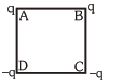
Charges are placed on the vertices of a square as shown. Let $E$ be the electric field and $V$ the potential at the centre. If the charges on $A$ and $B$ are interchanged with those on $D$ and $C$ respectively, then 
A uniform wire of resistance $50\Omega$ is cut into 5 equal parts. These parts are now connected in parallel. The equivalent resistance of the combination is:
The resolving power of an astronomical telescope is $0.2\, sec$. If the central half portion of the objective lens is covered, the resolving power will be....$sec$
A long straight wire carries a current of $35\, A$. What is the magnitude of the field $B$ at a point $20\, cm$ from the wire ?
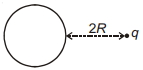
A positive point charge $q$ is placed at a distance $2 R$ from the surface of a metallic shell of radius $R$. The electric field at centre of shell due to induced charge has magnitude
In an intrinsic semiconductor, the density of conduction electron's is $7.07 \times 10^{15} \,m ^{-3}$. When it is doped with indium, the density of holes becomes $5 \times 10^{22} \,m ^{-3}$. Find the density of conduction electrons in doped semiconductor
A sheet of aluminium foil of negligible thickness is introduced between the plates of a capacitor. The capacitance of the capacitor:
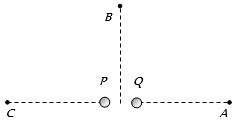
Figure here shows $P$ and $Q$ as two equally intense coherent sources emitting radiations of wavelength $20 \,m$. The separation $PQ$ is $5.0 \,m$ and phase of $P$ is ahead of the phase of $Q$ by $90^{0}$. $A, B $ and $ C$ are three distant points of observation equidistant from the mid-point of $PQ$. The intensity of radiations at $A, B, C$  will bear the ratio
Assertion : In electric circuits, wires carrying currents in opposite directions are often twisted together

Reason : If the wires are not twisted together, the combination of the wires forms a current loop, the magnetic field generated by the loop might affect adjacent circuits or components.