In a simple pendulum, the period of oscillation $T$ is related to length of the pendulum $l$ as
Easy
Download our app for free and get started
(c) $T = 2\pi \sqrt {\frac{l}{g}} $
$\Rightarrow \frac{l}{{{T^2}}} = \frac{g}{{4{\pi ^2}}} = $ constant

Download our appand get started for free
Experience the future of education. Simply download our apps or reach out to us for more information. Let's shape the future of learning together!No signup needed.*
Similar Questions
- 1A point performs simple harmonic oscillation of period $T$ and the equation of motion is given by $x=Asin$$\left( {\omega t + \frac{\pi }{6}} \right)$. After the elapse of what fraction of the time period the velocity of the point will be equal to half of its maximum velocity?View Solution
- 2If the length of second's pendulum is decreased by $2\%$, how many seconds it will lose per day ...... $\sec$View Solution
- 3A body performs $S.H.M.$ Its kinetic energy $K$ varies with time $t$ as indicated by graphView Solution
- 4A simple pendulum, suspended from the ceiling of a stationary van, has time period $T$. If the van starts moving with a uniform velocity the period of the pendulum will beView Solution
- 5Two, spring $P$ and $Q$ of force constants $k_p$ and ${k_Q}\left( {{k_Q} = \frac{{{k_p}}}{2}} \right)$ are stretched by applying forces of equal magnitude. If the energy stored in $Q$ is $E$, then the energy stored in $P$ isView Solution
- 6For a particle executing $S.H.M.,\, x =$ displacement from equilibrium position, $v =$ velocity at any instant and $a =$ acceleration at any instant, thenView Solution
- 7The ratio of maximum acceleration to maximum velocity in a simple harmonic motion is $10\,s^{-1}$. At, $t = 0$ the displacement is $5\, m$. What is the maximum acceleration ? The initial phase is $\frac{\pi }{4}$View Solution
- 8The function $sin^2\,(\omega t)$ representsView Solution
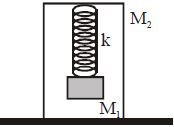
- 9$A$ block of mass $M_1$ is hanged by a light spring of force constant $k$ to the top bar of a reverse Uframe of mass $M_2$ on the floor. The block is pooled down from its equilibrium position by $a$ distance $x$ and then released. Find the minimum value of $x$ such that the reverse $U$ -frame will leave the floor momentarily.View Solution
- 10Two particles are in $SHM$ on same straight line with amplitude $A$ and $2A$ and with same angular frequency $\omega .$ It is observed that when first particle is at a distance $A/\sqrt{2}$ from origin and going toward mean position, other particle is at extreme position on other side of mean position. Find phase difference between the two particlesView Solution