The ratio of maximum acceleration to maximum velocity in a simple harmonic motion is $10\,s^{-1}$. At, $t = 0$ the displacement is $5\, m$. What is the maximum acceleration ? The initial phase is $\frac{\pi }{4}$
JEE MAIN 2017, Diffcult
Download our app for free and get started
Maximum velocity in $\mathrm{SHM}, \mathrm{v}_{\max }=\mathrm{a} \omega$
Maximum acceleration in $\mathrm{SHM}, \mathrm{A}_{\max }=\mathrm{a} \omega^{2}$
where $a$ and $\omega$ are maximum amplitude and angular frequency.
Given that, $\frac{A_{\max }}{v_{\max }}=10$
i.e., $\omega=10 \mathrm{s}^{-1}$
Displacement is given by
Maximum acceleration in $\mathrm{SHM}, \mathrm{A}_{\max }=\mathrm{a} \omega^{2}$
where $a$ and $\omega$ are maximum amplitude and angular frequency.
Given that, $\frac{A_{\max }}{v_{\max }}=10$
i.e., $\omega=10 \mathrm{s}^{-1}$
Displacement is given by
$x=a \sin (\omega t+\pi t 4)$
at $t=0, x=5$
$5=a \sin \pi / 4$
$5=a \sin 45^{\circ} \Rightarrow a=5 \sqrt{2}$
Maximum acceleration $\mathrm{A}_{\mathrm{max}}=\mathrm{a} \omega^{2}$
$=500\sqrt{2}\,m/s^2$

Download our appand get started for free
Experience the future of education. Simply download our apps or reach out to us for more information. Let's shape the future of learning together!No signup needed.*
Similar Questions
- 1The piston in the cylinder head of locomotive has a stroke of $6\,m$ (which is twice the amplitude). If the piston executing simple harmonic motion with an angular frequency of $200\, rad\, min^{-1}$, its maximum speed is .... $ms^{-1}$View Solution
- 2A particle of unit mass is moving along the $x$-axis under the influence of a force and its total energy is conserved. Four possible forms of the potential energy of the particle are given in column $I$ (a and $U _0$ are constants). Match the potential energies in column $I$ to the corresponding statement$(s)$ in column $II.$View Solution
column $I$ column $II$ $(A)$ $U _1( x )=\frac{ U _0}{2}\left[1-\left(\frac{ x }{ a }\right)^2\right]^2$ $(P)$ The force acting on the particle is zero at $x = a$. $(B)$ $U _2( x )=\frac{ U _0}{2}\left(\frac{ x }{ a }\right)^2$ $(Q)$ The force acting on the particle is zero at $x=0$. $(C)$ $U _3( x )=\frac{ U _0}{2}\left(\frac{ x }{ a }\right)^2 \exp \left[-\left(\frac{ x }{ a }\right)^2\right]$ $(R)$ The force acting on the particle is zero at $x =- a$. $(D)$ $U _4( x )=\frac{ U _0}{2}\left[\frac{ x }{ a }-\frac{1}{3}\left(\frac{ x }{ a }\right)^3\right]$ $(S)$ The particle experiences an attractive force towards $x =0$ in the region $| x |< a$. $(T)$ The particle with total energy $\frac{ U _0}{4}$ can oscillate about the point $x=-a$. - 3The amplitude of a particle executing $SHM$ about $O$ is $10\, cm.$ Then :View Solution
- 4Starting from the mean position a body oscillates simple harmonically with a period of $2\,s.$ After what time will its kinetic energy be $75\%$ of the total energy ?View Solution
- 5For a particle executing $S.H.M.,\, x =$ displacement from equilibrium position, $v =$ velocity at any instant and $a =$ acceleration at any instant, thenView Solution
- 6A simple harmonic motion is represented by $F(t) = 10\sin \,(20\,t + 0.5)$. The amplitude of the $S.H.M.$ is $a$ $=$ ....View Solution
- 7The equation of $S.H.M.$ is $y = a\sin (2\pi nt + \alpha )$, then its phase at time $t$ isView Solution
- 8Two damped spring-mass oscillating systems have identical spring constants and decay times. However, system $A's$ mass $m_A$ is twice system $B's$ mass $m_B$ . How do their damping constants, $b$ , compare ?View Solution
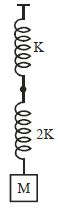
- 9Two springs of force constant $K$ and $2K$ are connected to a mass as shown below. The frequency of oscillation of the mass isView Solution
- 10When a mass $M$ is attached to the spring of force constant $k$, then the spring stretches by $l$. If the mass oscillates with amplitude $l$, what will be maximum potential energy stored in the springView Solution