MCQ
In a transistor the collector current is always less than the emitter current because
  • A
    Collector side is reverse biased and the emitter side is forward biased
  • A few charge carriers are lost in the base and only remaining ones reach the collector
  • C
    Collector being reverse biased, attracts less electrons
  • D
    Collector side is forward biased and emitter side is reverse biased
Answer

Correct option: B.
A few charge carriers are lost in the base and only remaining ones reach the collector
b
$I_E = I_B + I_C$

Need a full question paper?

Generate a complete, print-ready paper with questions like this in minutes — across 16+ boards, with answer keys.

Start Generating Free

Similar questions

Which among the following has a frequency range of $500\ kHz$ to $1000\ MHz?$
Which of the following graphs shows appropriate variation of refractive index $\mu$ with wavelength $\lambda$
The plates of a parallel plate condenser are pulled apart with a velocity $v$. If at any instant their mutual distance of separation is $d$, then the magnitude of the time of rate of change of capacity depends on $d$ as follows
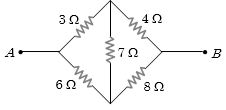
Calculate the net resistance of the circuit between $A$ and $B$
A green light is incident from the water to the air - water interface at the critical angle $(\theta)$. Select the correct statement .
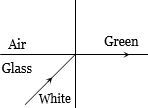
White light is incident on the interface of glass and air as shown in the figure. If green light is just totally internally reflected then the emerging ray in air contains
The photoelectric effect is based on the law of conservationof:
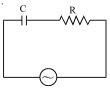
In the circuit shown if the $emf$ of source at an instant is $5\, V$, the potential difference across capacitor at the same instant is $4\, V$. The potential difference across $R$ at that instant may be .....$V$
A change of 0.8 mA in the anode current of a triode occurs when the anode potential is changed by 10 V. If m = 8 for the triode, then what change in the grid voltage would be required to produce a change of 4 mA in the anode current
An ac circuit has an inductor and a resistor of resistance ${R}$ in series, such that ${X}_{{L}}=3 {R}$. Now, a capacitor is added in series such that ${X}_{{C}}=2 {R}$. The ratio of new power factor with the old power factor of the circuit is $\sqrt{5}: {x}$. The value of ${x}$ is ...... .