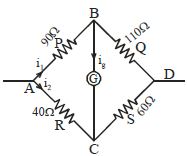
In a Wheatstone bridge, $P = 90\,\Omega $, $Q = 110\,\Omega $ , $R = 40\,\Omega $ and $S = 60\,\Omega $ and a cell of $4\,V\,emf$. Then the potential difference between the diagonal along which a galvanometer is connected is ............. $V$
Medium


Download our appand get started for free
Experience the future of education. Simply download our apps or reach out to us for more information. Let's shape the future of learning together!No signup needed.*
Similar Questions
- 1View SolutionIn meter bridge or Wheatstone bridge for measurement of resistance, the known and the unknown resistances are interchanged. The error so removed is
- 2A potentiometer wire has length $4\,\, m$ and resistance $8\,\,\Omega $. The resistance that must be connected in series with the wire and an accumulator of e.m.f. $2\,\, V,$ so as to get a potential gradient $1\,\, m \,V$ per $cm$ on the wire is ............. $\Omega$View Solution
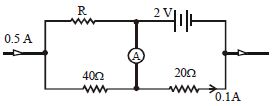
- 3In the circuit shown in the figure, no current flows through the ideal ammeter. If the internal resistance of the cell is negligible, the value of unknown resistance $R $ is .............. $\Omega$View Solution
- 4Two bulbs of $(40 \;W, 200\; V)$ and $(100\; W, 200 \;V)$. Then correct relation for their resistanceView Solution
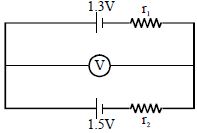
- 5In given diagram ideal voltmeter $V$ reads $1.45\,V$ then relation between $r_1$ and $r_2$ isView Solution
- 6$10$ wires (same length, same area, same material) are connected in parallel and each has $1$ $\Omega$ resistance, then the equivalent resistance will be .............. $\Omega$View Solution
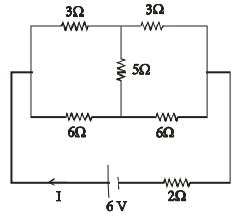
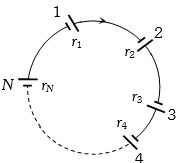
- 7A group of $N$ cells whose $emf$ varies directly with the internal resistance as per the equation $E_N = 1.5\, r_N$ are connected as shown in the figure below. The current $I$ in the circuit is ........... $amp$View Solution
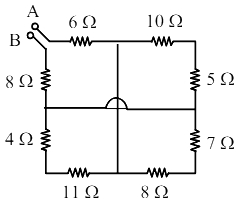
- 8The equivalent resistance between $A$ and $B$ is:View Solution
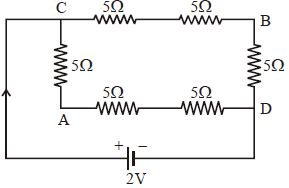
- 9In the adjoining circuit shown the potential difference between points $A$ and $B$ will beView Solution
- 10A battery of $6\,V$ is connected to the circuit as shown below. The current I drawn from the battery is:View Solution