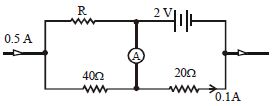
In the circuit shown in the figure, no current flows through the ideal ammeter. If the internal resistance of the cell is negligible, the value of unknown resistance $R $ is .............. $\Omega$
Medium
Download our app for free and get started
If no current flows through the ammeter $(1),$ potential on the $20 \mathrm{\,W}$ resistance becomes $2 \mathrm{\,V}.$
$\Rightarrow \mathrm{R}=\frac{4 \mathrm{V}}{0.4 \mathrm{\,A}}=10\, \Omega$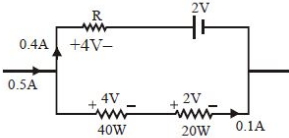

Download our appand get started for free
Experience the future of education. Simply download our apps or reach out to us for more information. Let's shape the future of learning together!No signup needed.*
Similar Questions
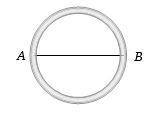
- 1The resistance of a wire is ${10^{ - 6}}\,\Omega $ per meter. It is bend in the form of a circle of diameter $2\,m$. A wire of the same material is connected across its diameter. The total resistance across its diameter $AB$ will beView Solution
- 2For a cylinder of radius $R$ current density $J =J_0 \frac{r}{R} $, where $J_0$ is a constant and $r$ is distance from axis. Calculate total currentView Solution
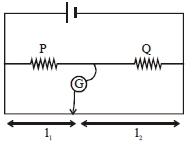
- 3For a cell terminal $P.D.$ is $2.2\;V$ when circuit is open and reduces to $1.8\;V$ when cell is connected to a resistance of $R = 5\,\Omega $. Determine internal resistance of cell $(r)$ is then ........ $\Omega$View Solution
- 4Refer to the circuit shown. What will be the total power dissipation in the circuit if $P$ is the power dissipated in $R_1$ ? It is given that $R_2=4 R_1$ and $R_3=12 R_1$ are .......... $P$View Solution
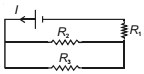
- 5The equivalent resistance between $A$ and $B$ is:View Solution
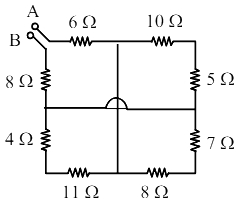
- 6In the circuit here, the steady state voltage across capacitor $C$ is a fraction of the battery $e.m.f.$ The fraction is decided byView Solution
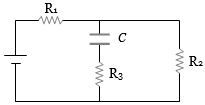
- 7View SolutionAssertion : Free electrons always keep on moving in a conductor even then no magnetic force act on them in magnetic field unless a current is passed through it.
Reason : The average velocity of free electron is zero.
- 8In the circuit shown here, $E_1 = E_2 = E_3 = 2 V$ and $R_1 = R_2 = 4\,ohms$. The current flowing between points $A$ and $B$ through battery $E_2$ isView Solution
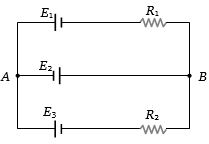
- 9What is the equivalent resistance of the circuit ............. $\Omega$View Solution
- 10The meter bridge shown is in balanced position with $\frac{\mathrm{P}}{\mathrm{Q}}=\frac{\mathrm{l}_{1}}{\mathrm{l}_{2}}$. If we now litterchange the positions of gavanometer and cell, will the bridge work? If yes, what will be balance condition?View Solution