Question
In a Young's double slit experiment using monochromatic light, the fringe pattern shifts by a certain distance on the screen when a mica sheet of refractive index 1.6 and thickness 1.964 micron (1 micron = 10-6m) is introduced in the path of one of the interfering waves. The mica sheet is then removed and the distance between the screen and the slits is doubled. It is found that the distance between the successive maxima now is the same as the observed fringe-shift upon the introduction of the mica sheet. Calculate the wavelength of the monochromatic light used in the experiment.
Answer

In the given Young’s double slit experiment,
$\mu=1.6,$ t = 1.964 micron = 1.964 × 10⁻⁶m
We know, number of fringes shifted $=\frac{(\mu-1)\text{t}}{\lambda}$
So, the corresponding shift = No.of fringes shifted × fringe width
$=\frac{(\mu-1)\text{t}}{\lambda}\times\frac{\lambda\text{D}}{\text{d}}=\frac{(\mu-1)\text{tD}}{\text{d}}\ ...(1)$
Again, when the distance between the screen and the slits is doubled,
Fringe width $=\frac{\lambda(2\text{D})}{\text{d}}\ ...(2)$
From (1) and (2), $\frac{(\mu-1)\text{tD}}{\text{d}}=\frac{\lambda(2\text{D})}{\text{d}}$
$\Rightarrow\lambda=\frac{(\mu-1)\text{t}}{\lambda}$
$=\frac{(1.6-1)\times(1.964)\times10^{-6}}{2}=589.2\times10^{-9}=589.2\text{nm}.$

Need a full question paper?

Generate a complete, print-ready paper with questions like this in minutes — across 16+ boards, with answer keys.

Start Generating Free

Similar questions

A tightly-wound, long solenoid is kept with its axis parallel to a large metal sheet carrying a surface current. The surface current through a width dl of the sheet is Kdl and the number of turns per unit length of the solenoid is n. The magnetic field near the centre of the solenoid is found to be zero.
  1. Find the current in the solenoid.
  2. If the solenoid is rotated to make its axis perpendicular to the metal sheet, what would be the magnitude of the magnetic field near its centre ?
4 × 10²³ tritium atoms are contained in a vessel. The half-life of decay tritium nuclei is 12.3y. Find:
  1. The activity of the sample.
  2. The number of decay in the next 10 hours.
  3. The number of decays in the next 6.15y.
Find the diameter of the image of the moon formed by a spherical concave mirror of focal length 7.6m. The diameter of the moon is 3450km and the distance between the earth and the moon is 3.8 × 10⁵km.
Two capacitors of capacitances 20.0pF and 50.0pF are connected in series with a 6.00V battery. Find:
  1. The potential difference across each capacitor.
  2. The energy stored in each capacitor.
Total charge -Q is uniformly spread along length of a ring of radius R. A. small test charge +q of mass m is kept at the centre of the ring and is given a gentle push along the axis of the ring.
  1. Show that the particle executes a simple harmonic oscillation.
  2. Obtain its time period.
Find the charge required to flow through an electrolyte to liberate one atom of.
  1. A monovalent material.
  2. A divalent material.
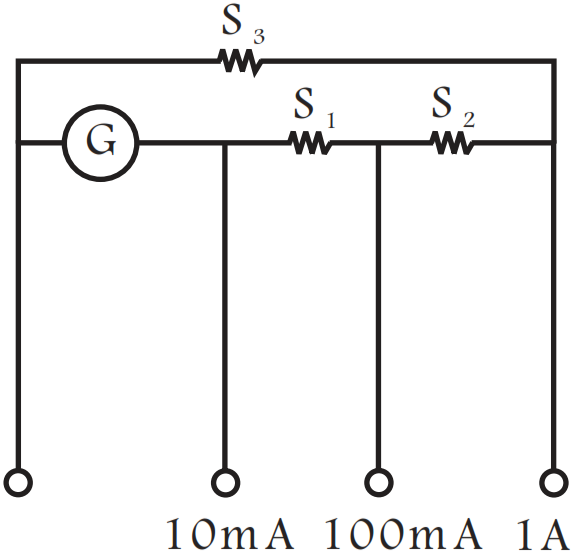
A multirange current meter can be constructed by using a galvanometer circuit as shown in Fig. We want a current meter that can measure 10mA, 100mA and 1A using a galvanometer of resistance 10Ω and that prduces maximum deflection for current of 1mA. Find S1, S2 and S3 that have to be used.

Ten positively charged particles are kept fixed on the x-axis at points x = 10cm, 20cm, 30cm, ..., 100cm. The first particle has a charge 1.0 × 10-8C, the second 8 × 10-8C, the third 27 × 10-8C and so on. The tenth particle has a charge 1000 × 10-8C. Find the magnitude of the electric force acting on a 1C charge placed at the origin.
A charged particle is accelerated through a potential difference of 12kV and acquires a speed of 1.0 × 10⁶m s−1. It is then injected perpendicularly into a magnetic field of strength 0.2T. Find the radius of the circle described by it.