Question
In a Young's double slit interference experiment the fringe pattern is observed on a screen placed at a distance D from the slits. The slits are separated by a distance d and are illuminated by monochromatic light of wavelength $\lambda$. Find the distance from the central point where the intensity falls to,
  1. Half the maximum.
  2. One fourth of the maximum.

Answer

  1. When intensity is half the maximum $\frac{\text{I}}{\text{I}_\text{max}}=\frac{1}{2}$

$\Rightarrow\frac{4\text{a}^2\cos^2\big(\frac{\phi}{2}\big)}{4\text{a}^2}=\frac{1}{2}$

$\Rightarrow\cos^2\Big(\frac{\phi}{2}\Big)=\frac{1}{2}\Rightarrow\cos\Big(\frac{\phi}{2}\Big)=\frac{1}{\sqrt{2}}$

$\Rightarrow\frac{\phi}{2}=\frac{\pi}{4}\Rightarrow\phi=\frac{\pi}{2}$

$\Rightarrow$ Path difference, $\text{x}=\frac{\lambda}{4}$

$\Rightarrow\text{y}=\frac{\text{xD}}{\text{d}}=\frac{\lambda\text{D}}{4\text{d}}$

  1. When intensity is $\frac{1}{4}\text{th}$ of the maximum $\frac{\text{I}}{\text{I}_\text{max}}=\frac{1}{4}$

$\Rightarrow\frac{4\text{a}^2\cos^2\Big(\frac{\phi}{2}\Big)}{4\text{a}^2}=\frac{1}{4}$

$\Rightarrow\cos^2\Big(\frac{\phi}{2}\Big)=\frac{1}{4}\Rightarrow\cos\Big(\frac{\phi}{2}\Big)=\frac{1}{2}$

$\Rightarrow\frac{\phi}{2}=\frac{\pi}{3}\Rightarrow\phi=\frac{2\pi}{3}$

$\Rightarrow$ Path difference, $\text{x}=\frac{\lambda}{3}$

$\Rightarrow\text{y}=\frac{\text{xD}}{\text{d}}=\frac{\lambda\text{D}}{3\text{d}}$
Need a full question paper?

Generate a complete, print-ready paper with questions like this in minutes — across 16+ boards, with answer keys.

Start Generating Free

Similar questions

Suppose the particle of the previous problem has a mass m and a speed v before the collision and it sticks to the rod after the collision. The rod has a mass M:
  1. Find the velocity of the centre of mass C of the system constituting ''The rod plus the particle''.
  2. Find the velocity of the particle with respect to C before the collision.
  3. Find the velocity of the rod with respect to C before the collision.
  4. Find the angular momentum of the particle and of the rod about the centre of mass C before the collision.
  5. Find the moment of inertia of the system about the vertical axis through the centre of mass C after the collision.
  6. Find the velocity of the centre of mass C and the angular velocity of the system about the centre of mass after the collision.
Define magnifying power of a telescope. Write its expression.
A small telescope has an objective lens of focal length 150 cm and an eye piece of focal length 5 cm. If this telescope is used to view a 100m high tower 3 km away, find the height of the final image when it is formed 25 cm away from the eye piece.
A spherical tungsten piece of radius 1.0cm is suspended in an evacuated chamber maintained at 300K. The piece is maintained at 1000K by heating it electrically. Find the rate at which the electrical energy must be supplied. The emissivity of tungsten is 0.30 and the Stefan constant $\sigma$ is 6.0 × 10-8Wm-2K-4.
Determine the ‘effective focal length’ of the combination of the two lenses in if they are placed 8.0 cm apart with their principal axes coincident. Does the answer depend on which side of the combination a beam of parallel light is incident? Is the notion of effective focal length of this system useful at all.
Asha’s mother read an article in the newspaper about a disaster that took place at Chernobyl. She could not understand much from the article and asked a few questions from Asha regarding the article. Asha tried to answer her mother’s questions based on what she learnt in Class XII Physics.
  1. What was the installation at Chernobyl where the disaster took place? What, according to you, was the cause of this disaster?
  2. Explain the process of release of energy in the installation at Chernobyl.
  3. What, according to you, were the values displayed by Asha and her mother?
Consider a p-n junction diode having the characteristic $\text{i}-\text{i}_0\Big(\text{e}^{\frac{\text{eV}}{\text{kT}}}-1\Big)$ where $\text{i}_0=20\mu\text{A}.$ The diode is operated at T = 300K.
  1. Find the current through the diode when a voltage of 300mV is applied across it in forward bias.
  2. At what voltage does the current double?
  1. Two insulated charged copper spheres A and B have their centres separated by a distance of 50 cm. What is the mutual force of electrostatic repulsion if the charge on each is 6.5 × 10⁻⁷ C? The radii of A and B are negligible compared to the distance of separation.
  2. What is the force of repulsion if each sphere is charged double the above amount, and the distance between them is halved?
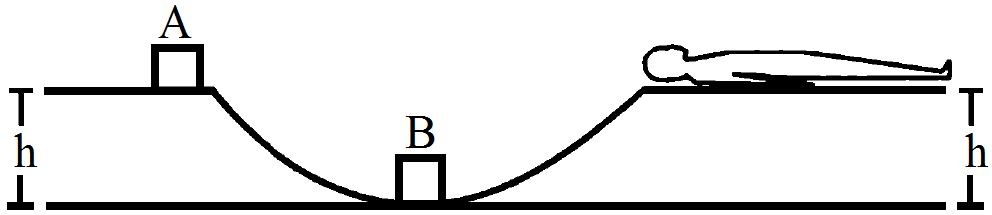
The track shown in figure is frictionless. The block B of mass 2m is lying at rest and the block A of mass m is pushed along the track with some speed. The collision between A and B is perfectly elastic. With what velocity should the block A be started to get the sleeping man awakened?

Repeat part (a) of problem 6 if the push is applied horizontally and not parallel to the incline.
Ajit had a high tension tower erected on his farm land. He kept complaining to the authorities to remove it as it was occupying a large portion of his land. His uncle, who was a teacher, explained to him the need for erecting these towers for efficient transmission of power. As Ajit realised its significance, he stopped complaining. 
Answer the following questions:
  1. Why is it necessary to transport power at high voltage?
  2. A low power factor implies large power loss. Explain.
  3. Write two values each displayed by Ajit and his uncle.