MCQ
In a zener diode, break down occurs in reverse bias due to
  • A
    Impactionisation
  • Internal field emission
  • C
    High doping concentration
  • D
    All of these

Answer

Correct option: B.
Internal field emission
b
(b)

Need a full question paper?

Generate a complete, print-ready paper with questions like this in minutes — across 16+ boards, with answer keys.

Start Generating Free

Similar questions

In series connection of resistors, what happens to the current across each resistor?
The electric potential (V) inside a uniformly charged. spherical shell depends on distance:
Match the List $-I$ (Phenomenon associated with electromagnetic radiation) with List $-II$ (Part of electromagnetic spectrum) and select the correct code from the choices given below this lists
  List $I$   List $II$
$I$ Doublet of sodium $(A)$ Visible radiation
$II$ Wavelength corresponding to temperature associated with the isotropic radiation filling all space $(B)$ Microwave
$III$ Wavelength emitted by atomic hydrogen in interstellar space $(C)$ Short radio wave
$IV$ Wavelength of radiation arising from two close energy levels in hydrogen $(D)$ $X-$ rays
A proton and an alpha particle both enter a region of uniform magnetic field $B,$ moving at right angles to field $B$. If the radius of circular orbits for both the particles is equal and the kinetic energy acquired by proton is $1 \ MeV$ the energy acquired by the alpha particle will be:
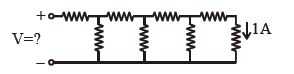
Each element in the finite chain of resistors shown in the figure is $\,1\,\Omega $ . A current of $1\, A$ flows through the final element. Then what is the potential difference $V$ across input terminals of the chain .................. $\mathrm{volt}$
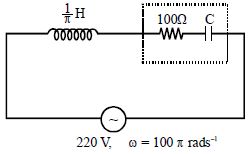
In the circuit shown in figure if the value of $rms$ current is $2.2\, A$ the power factor of the box is 
Four charges are kept at the corner points of a square. The net force on a charge kept at the center of the square is $........$?
The lowest resistance which can be obtained by connecting $10$ resistors each of $1/10$ $ohm$ is
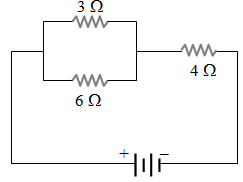
In the figure, current through the 3 Ω resistor is 0.8 ampere, then potential drop through 4 Ω resistor is

In Bohr's model of hydrogen atom, let $PE$ represents potential energy and $TE$ the total energy. In going to a higher level