MCQ
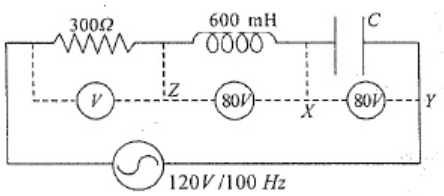
In above circuit, what is the potential drop across ZY?
Image
  • A
    160 V
  • B
    $80\sqrt{80}$
  • C
    80 V
  • D
    zero

Answer

  1. zero

Explanation:

VZY ​= VC ​- VL ​= 0

Need a full question paper?

Generate a complete, print-ready paper with questions like this in minutes — across 16+ boards, with answer keys.

Start Generating Free

Similar questions

Absorption of X-ray is maximum in which of the following different sheets

(a) Copper

(b) Gold

(c) Beryllium

(d) Lead

The energy stored per unit volume of a space is called as:

Three resistances of one ohm each are connected in parallel. Such connection is again connected with 2/3 Ω  resistor in series. The resultant resistance will be

(a)      

(b)  

(c) 1 Ω     

(d)  

An experiment to verify ohm's law, a conductor of resistance R is taken. During the experiment, temperature of the conductor increases with the flow of current. Resistance of the conductor will:
Two particles A and B have a phase difference of $\pi$ when a sine wave passes through the region.
  1. A oscillates at half the frequency of B.
  2. A and B move in opposite directions.
  3. A and B must be separated by half of the wavelength.
  4. The displacements at A and B have equal magnitudes.
In a radioactive decay, neither the atomic number nor the mass number changes. Which of the following particles is emitted in the decay?

Gases begin to conduct electricity at low pressure because

(a) At low pressure, gases turn to plasma

(b) Colliding electrons can acquire higher kinetic energy due to increased mean free path leading to ionisation of atoms

(c) Atoms break up into electrons and protons

(d) The electrons in atoms can move freely at low pressure

A symmetric double convex lens is cut in two equal parts by a plane perpendicular to the principal axis. If the power of the original lens was 4D, the power of a cutlens will be:
  1. 2D
  2. 3D
  3. 4D
  4. 5D.
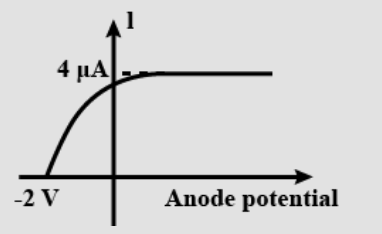
The graph shown below depicts plot of photocurrent versus anode potential for a cathode with 4 eV work function. The energy of the incident photon is:

Kirchoff’s first law, i.e., S i = 0 at a junction, deals with the conservation of: