MCQ
The graph shown below depicts plot of photocurrent versus anode potential for a cathode with 4 eV work function. The energy of the incident photon is:
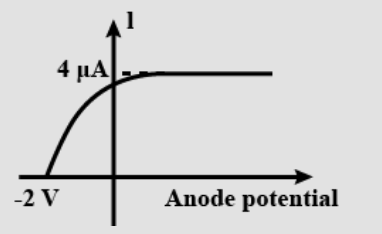
- A6eV
- B4eV
- C2eV
- D8eV
Explanation:
It is given that
Work function
$\phi$ = 4eV
V = 2V
From Einstein’s relation
hν = $\phi$ + Ek
Where hν is the energy of photons. And Ek is the kinetic energy
hν = (4+2)eV
hν = 6eV
Generate a complete, print-ready paper with questions like this in minutes — across 16+ boards, with answer keys.
Calculate the amount of charge flowing in 2 minutes in a wire of resistance 10 W when a potential difference of 20 V is applied between its ends
|
(a) 120 C |
(b) 240 C |
(c) 20 C |
(d) 4 C |
Faraday’s 2nd law states that mass deposited on the electrode is directly proportional to
|
(a) Atomic mass |
(b) Atomic mass × Velocity |
|
(c) Atomic mass/Valency |
(d) Valency |
An electron has mass 9  and charge 1.6
  is moving with a velocity of
  , enters a region where magnetic field exists. If it describes a circle of radius 0.10 m, the intensity of magnetic field must be
|
(a) 1.8 |
(b) 5.6 |
(c) 14.4 |
(d) 1.3 |
In the arrangement of resistances shown below, the effective resistance between points A and B is

|
(a) 20 Ω |
(b) 30 Ω |
(c) 90 Ω |
(d) 110 Ω |
Cathode rays consist of
|
(a) Photons |
(b) Electrons |
(c) Protons |
(d) α -particles |
Two free parallel wires carrying currents in opposite direction
| (a) Attract each other |
| (b) Repel each other |
| (c) Neither attract nor repel |
| (d) Get rotated to be perpendicular to each other |
The ratio of the energy of an X-ray photon of wavelength 1 Å to that of visible light of wavelength 5000 Å is
| (a) 1: 5000 | (b) 5000 : 1 | (c) 1 :25 × 106 | (d) 25 × 106 |


