MCQ
In an AC series circuit, the instantaneous current is zero when the instantaneous voltage is maximum. Connected to the source may be a:
- APure inductor.
- BPure capacitor.
- CPure resistor.
- DCombination of an inductor and a capacitor.
Pure inductor.
Pure capacitor.
Explanation:
Instantaneous current is zero when the intantaneous voltage is maximum.
Mean resistance = 0.
Generate a complete, print-ready paper with questions like this in minutes — across 16+ boards, with answer keys.
The force between two charges 0.06 m apart is 5 N. If each charge is moved towards the other by 0.01 m, then the force between them will become
|
(a) 7.20 N |
(b) 11.25 N |
(c) 22.50 N |
(d) 45.00 N |
In a transformer, the coefficient of mutual inductance between the primary and the secondary coil is 0.2 henry. When the current changes by 5 ampere/second in the primary, the induced e.m.f. in the secondary will be
|
(a) 5 V |
(b) 1 V |
(c) 25 V |
(d) 10 V |
Assertion : The coil is bound over the metallic frame in moving coil galvanometer.
Reason : The metallic frame help in making steady deflection without any oscillation.
|
(a) If both assertion and reason are true and the reason is the correct explanation of the assertion. |
|
(b) If both assertion and reason are true but reason is not the correct explanation of the assertion. |
|
(c) If assertion is true but reason is false. |
|
(d) If the assertion and reason both are false. |
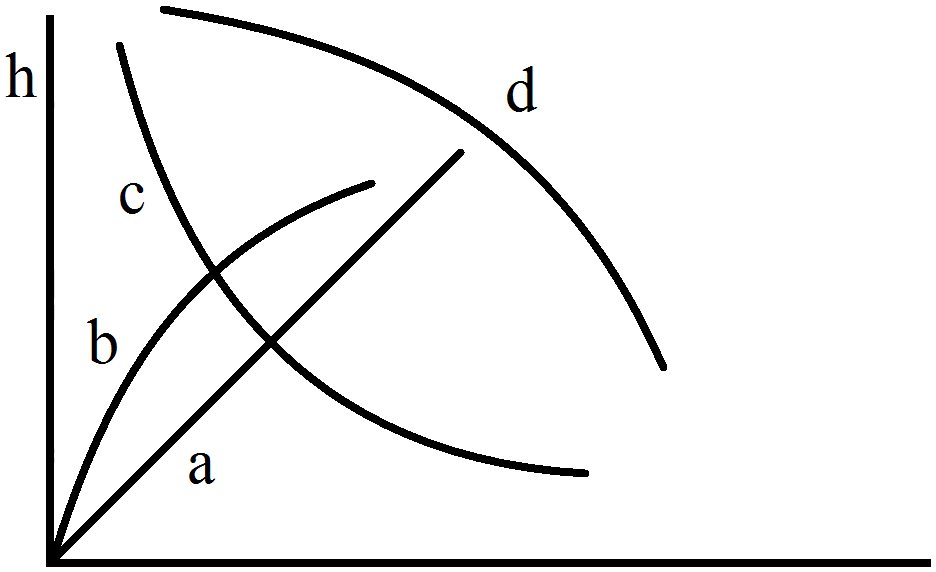
In Bohr's model of hydrogen atom, let PE represents potential energy and TE the total energy. In going to a higher level
|
(a) PE decreases, TE increases |
(b) PE increases, TE increases |
|
(c) PE decreases, TE decreases |
(d) PE increases, TE decreases |
The light reflected by a plane mirror may form a real image
|
(a) If the rays incident on the mirror are diverging |
|
(b) If the rays incident on the mirror are converging |
|
(c) If the object is placed very close to the mirror |
|
(d) Under no circumstances |
The transfer ratio of a transistor is 50. The input resistance of the transistor when used in the common-emitter configuration is 1 KW. The peak value for an A.C input voltage of 0.01 V peak is
|
(a) 100 mA |
(b) 0.01 mA |
(c) 0.25 mA |
(d) 500 mA |
To explain his theory, Bohr used
|
(a) Conservation of linear momentum |
|
(b) Conservation of angular momentum |
|
(c) Conservation of quantum frequency |
|
(d) Conservation of energy |