- ✓200
- B100
- C50
- D20
50 questions · timed · auto-graded
Explanation:
In an LC circuit current oscillates between, maximum and minimum value. So, LC circuit needs oscillations (electrical). It occurs due to discharging and charging of capacitor and magnetisation and demagnetisation of inductor
Explanation:
The rated voltage in bulb is rms voltage.
$\text{V}_\text{rms}=\frac{\text{V}_0}{\sqrt{2}}$
$\text{V}_0=\sqrt{2}\times220=311.08\text{V}$
Explanation:
$\text{V}=\sqrt{\text{V}_\text{R}^2+(\text{V}_\text{C}-\text{V}_\text{L})^2}=10\text{V}$
VC > VL, hence current leads the voltage.
Power factor
$=\cos\phi=\frac{8}{10}=0.8$Explanation:
Current leads by 90°.
Explanation:
Inductive reactance or capacitive reactance are the impedance of an AC circuit which has the units of ohms.
Explanation:
We need to find the average potential difference across the mixer. Here by average we mean average over a long period of time. As we know in one complete cycle, average voltage across the mixer is zero. (In one complete cycle current changes the direction and net voltage across a resistor is zero).
So when in one complete cycle voltage drop across the resistor is zero, then the average voltage drop across the resistor (mixer) is zero.
Explanation:
Our experts are building a solution for this.
Explanation:
DC dynamo or AC dynamo use to convert mechnical energy into electrial energy.
Solution:
This is the similar problem as we discussed above. In this problem, the current increases on increasing the frequency of supply. Hence, the reactance of the circuit must be decreased as increase in frequency. So, one element that must be connected is capacitor. We can also connect a resistor in series.
For a capacitive circuit,
$\text{X}_\text{C}=\frac{1}{\omega\text{C}}=\frac{1}{2\pi\text{fC}}$
When frequency increases, XC decreases. Hence current in the circuit increases.
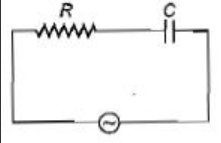
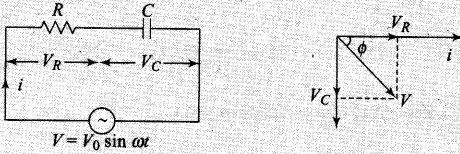
Importance point: Resistive, Capacitive Circuit (RC-Circuit)
VR = iR,
VC = iXC,
VR = iR

Applied voltage: $\text{V}=\sqrt{\text{V}^2_\text{R}+\text{V}^2_\text{C}}$
Impedance: $\text{Z}=\sqrt{\text{R}^2+\text{X}^2_\text{C}}=\sqrt{\text{R}^2+\Big(\frac{1}{\omega\text{C}}\Big)^2}$
Current: $\text{i}=\text{i}_0\sin(\omega\text{t}+\phi)$
Peak current: $\text{i}_0=\frac{\text{V}_0}{\text{Z}}=\frac{\text{V}_0}{\sqrt{\text{R}^2+\text{X}^2_\text{C}}}=\frac{\text{V}_0}{\sqrt{\text{R}^2+\frac{1}{4\pi^2\text{v}^2\text{C}^2}}}$
Phase difference: $\phi=\tan^{-1}\frac{\text{X}_\text{C}}{\text{R}}=\tan^{-1}\frac{1}{\omega\text{CR}}$
Power factor: $\cos\phi=\frac{\text{R}}{\sqrt{\text{R}^2+\text{X}^2_\text{C}}}$
Leading quantity: Current.
Solution:
Alternation currents are used for household supplies, which are having zero average value over a cycle.
The line is having some resistance, so power factor $\cos\phi=\frac{\text{R}}{\text{Z}}\neq0$
So, $\phi\neq\frac{\pi}{2}\Rightarrow\ \phi<\frac{2}{\pi}$
i.e., phase lies between 0 and $\frac{\pi}{2}$.
Important point: The average value of alternating quantity for one complete cycle is zero.
The average value of ac over half cycle $\Big(\text{t}=0\text{ to }\frac{\text{T}}{2}\Big)$
$\text{i}_\text{av}=\frac{\int_0^{\frac{\text{T}}{2}}\text{idt}}{\int_0^{\frac{\text{T}}{2}}\text{dt}}=0.637\text{i}_0=63.7\% \ \text{of i}_0$
Similarly $\text{V}_\text{av}=\frac{2\text{V}_0}{\pi}=0.637\text{V}_0=63.7\%\ \text{of V}_0.$
Explanation:
Capacitive reactance is given by. $\text{X}_\text{C}=\frac{1}{\text{wC}}$
Inductive reactance is given by $\text{X}_\text{L}={\text{wL}}$
At resonance, $\text{X}_\text{L}={\text{X}_\text{C}}\Rightarrow \text{w}\text{L}=\frac{1}{\text{wC}}$
But a frequency higher than resonance frequency, XL > XC
So the circuit behaves as a inductive circuit at a frequency higher that resonant frequency and the current lags behind the voltage in an inductive circuit.

Explanation:
At resonance XL = XC
⇒ R & current is maximum but finite, which is
$\text{I}_\text{max}=\frac{\text{E}}{\text{R}}$ where E is applied voltag.

Explanation:
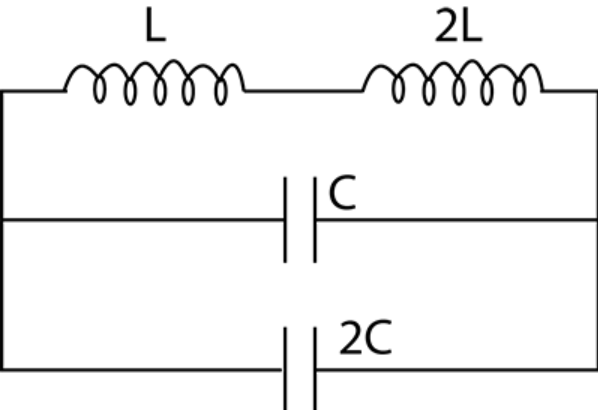
Equivalent inductance Leq = L + 2L = 3L
Ceq = C + 2C = 3C
$\therefore$ Frequency of oscillation $\text{f}=\frac{1}{2\pi\sqrt{\text{L}_\text{eq}\text{C}_\text{eq}}}=\frac{1}{6\pi\sqrt{\text{LC}}}$

Explanation:
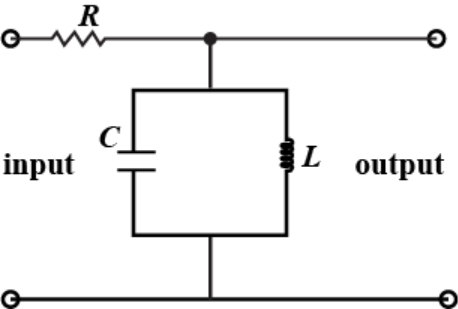
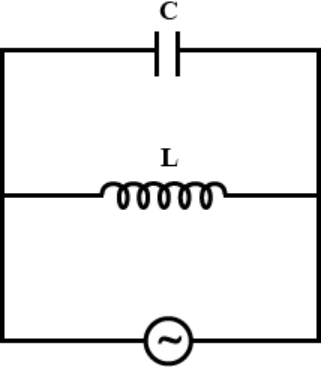
The circuit shown in figure has capacitor and inductor in parallel so their will be current flowing continuously with energy being transformed into electrical in capacitor and magnetic in inductor, hence it is a tuned filter.

Explanation:
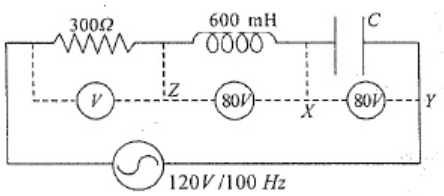
VZY = VC - VL = 0
Explanation:
Electric charge in alternating current (AC) changes direction periodically. The voltage in AC circuits also periodically reverses because the current changes direction.
Explanation:
Capacitors contain at least two electrical conductors separated by a dielectric/ insulator and is used to store energy electrostatically between the conductors. It acts like an open circuit and hence acts like an infinite resistance for DC currents.
Explanation:
The AC voltae across a resustance can be measured using a hot-wore volmeter.
Explanation:
$\text{V}_\text{rms}=220\text{V}$
$\text{V}_\text{p}=\sqrt{2}\times\text{V}_\text{rms}$
$=220\times1.414=311\text{volt}$
Explanation:
Z- Atomic number we study in modern physics
Z- impedance we study in alternating current
Z-zeta potential

Explanation:
$\text{V}^2={\text{V}^2_\text{R}}+{\text{V}^2_\text{c}}$
$20^2=12^2+\text{V}^2_\text{c}$
$\text{V}_\text{c}=\sqrt{20^2-12^2}$
$\text{V}_\text{c}=16\text{ V}$
Explanation:
In India, the frequency of AC voltage is 50 Hz.
It means 50 waves will be produced in 1 s.
In one wave, the direction is changed 2 times.
Thus, in 50 waves, the direction will be altered 50 × 2 = 100 times.
i.e. the direction is changed 100 times in 1 s.
Thus the direction is changed in every $\frac{1}{100}\text{second}$
Solution:
Key Concept: Resonant frequency (Natural frequency)
At resonance $\text{X}_\text{L}=\text{X}_\text{C}\Rightarrow\ \omega_0\text{L}=\frac{1}{\omega_0\text{C}}$
$\Rightarrow\ \omega_0=\frac{1}{\sqrt{\text{LC}}}\frac{\text{red}}{\sec}$
$\Rightarrow\ \text{v}_0=\frac{1}{2\pi\sqrt{\text{LC}}}\text{Hz}$
Resonant frequency in an L-C-R circuit is given by
$\text{v}_0=\frac{1}{2\pi\sqrt{\text{LC}}}$
If L or C increases, the resonant frequency will reduce.
To increase capacitance, we must connect another capacitor parallel to the first.
Explanation:
$\text{Z}=\sqrt{\text{R}^2+(\text{X}_\text{L}-\text{X}_\text{C})^2}$
$=\sqrt{(10)^2+(8-6)^2}$
$=\sqrt{10^2+2^2}$
$=\sqrt{100+4}$
$=10.2\Omega$
Explanation:
Capacitative reactance is an opposition to the change of voltage across an element.
It is denoted by XC and is inversely proportional to the signal frequency (f) and the capacitance C
$\text{X}_\text{c}=\frac{1}{2\pi\text{fc}}$
Explanation:
At resonance $\frac{1}{\omega\text{C}}=\omega\text{L}$
$\therefore$ impedance = R
Explanation:
Resonant frequency in series LCR circuit: $\omega=\sqrt{\frac{1}{\text{LC}}}$
Resonant frequency in series LCR circuit, $\omega=\sqrt{\frac{1}{\text{LC}}}=\sqrt{\frac{1}{\text{2L}\times\text{2C}}}=\frac{\omega}{2}$
Explanation:
For series C - R circuit, the impedance $\text{Z}=\sqrt{\text{R}^2+\text{X}^2_\text{C}}$ where $\text{X}_\text{C}=\frac{\text{i}}{\omega\text{C}}$ and current $\text{I}=\frac{\text{V}}{\text{Z}}$
When the capacitor is filled by mica, the capacitance will be increased. If C increases, XC decreases, so the current will increase and
hence voltage across resistance increases and voltage across capacitor decreases. thus, Va > Vb
Solution:
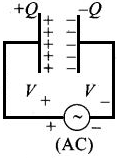
If the alternating voltage is applied to the capacitor, the plate connected to the positive terminal of the source will be at higher potential and the plate connected to the negative terminal of source will be at lower potential. So the plates capacitor is charged.

If $\text{V}=\text{V}_0\sin\omega\text{t},\text{Q}=\text{C V}_0\sin\omega\text{t}$ or we can say that Q and emf are in pahse.
As $\text{P}=\text{V}_\text{rms}\text{I}_\text{rms}\cos\phi$ and in case of a capacitor, $\phi=\frac{\pi}{2}\text{P} = 0,$ or we can say that power delivered to the capacitor is zero.
⇒ Pav = power delivered = 0.
Explanation:
Reactance is the nonresistive component of impedance in an AC circuit, arising from the effect of inductance or capacitance or both and causing the current to be out of phase with the electromotive force causing it.
Therefore, reactance of the L - C - R circuit is XL - XC.
Explanation:
$\text{Z}_\text{L}=\text{WL}\ \ \ \text{Z}_\text{C}=\frac{1}{\text{WC}}$
$\text{w}\uparrow,\text{Z}_\text{L}\uparrow\text{Z}_\text{c}\downarrow$
Explanation:
$\text{impedance}×\cos\theta = \text{resistance}$
$\text{impedance} = \frac{\text{resistance}}{\cos\theta}$
$=\frac{\sqrt{300}}{\frac{\cos\pi}{6}}$
$20\Omega$
Explanation:
In the above image waveform of current and voltage in puerly inductive circuit with time is shown.
It is clear from the image that current lags voltage by 90°.
Hence phase angle between current and voltage in purely inductive circuit is $\frac{\pi}{2}$
Solution:
According to the problem, XL = 1Ω, R = 2Ω,
Erms = 6V, Pav = ?
Average power dissipated in the circuit
$\text{P}_\text{av}=\text{E}_\text{rms}\text{I}_\text{rms}\cos\phi \ .....(\text{i})$
$\text{I}_\text{rms}=\frac{\text{E}_\text{rms}}{\text{Z}}$
$\text{Z}=\sqrt{\text{R}^2+\text{X}^2_\text{L}}$
$=\sqrt{4+1}=\sqrt{5}$
$\text{I}_\text{rms}=\frac{6}{\sqrt{5}}\text{A}$
$\cos\phi=\frac{\text{R}}{\text{Z}}=\frac{2}{\sqrt{5}}$
$\text{P}_\text{av}=6\times\frac{6}{\sqrt{5}}\times\frac{2}{\sqrt{5}}\ \ [\text{from Eq. (i)]}$
$=\frac{72}{\sqrt{5}\sqrt{5}}=\frac{72}{5}=14.4\text{W}$
Explanation:
Current leads voltage by $\frac{\pi}{2}$
$\therefore$ phase difference is $=\frac{\pi}{2}$
Explanation:
Supply voltage of an LCR circuit
$\text{V}=\sqrt{\text{V}^2_\text{R}+(\text{V}_\text{L}-\text{V}_\text{C})^2}$
since inductor and capacitor potentials are out of phase with each other
$=\sqrt{40^2+(60-30)^2\text{V}}$
$=50\text{V}$
Explanation:
Effective current is the rms value. Here, 220V is the labelled value of AC which is also the rms value. Hence,
$\text{I}_\text{rms}=\frac{\text{E}_\text{rms}}{\text{R}}$
$\text{I}_\text{rms}=\frac{220}{100\times10^3}$
$\text{I}_\text{rms}=2.2{\text{mA}}$
May be zero.
Explanation:
$\omega=2\pi\text{f}=2\times3.14\times50$
$\omega=314$
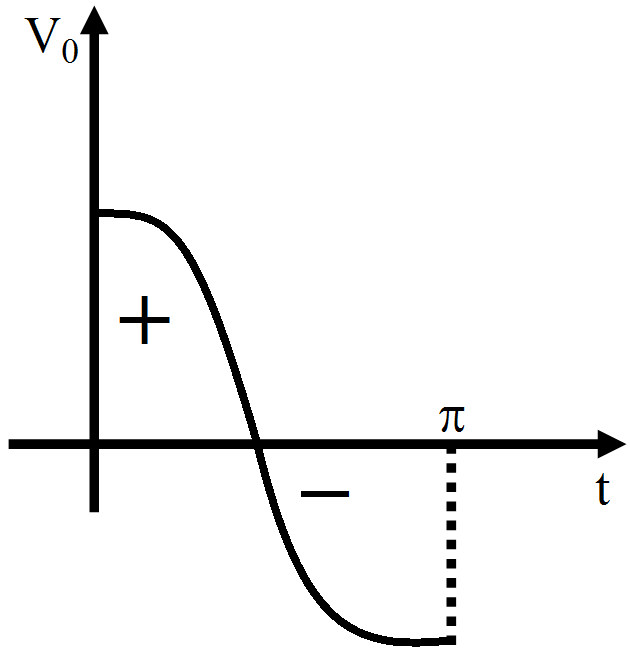
$\text{V}_\text{avg}=\frac{\int\limits_0^{0.01}\text{V}\text{dt}}{\int\limits_0^{0.01}\text{dt}}$
$=\text{V}_0\Big(\frac{1\cos\omega\text{t}}{\omega}\Big)_0^{0.01}$
$=\frac{\text{V}_0}{\omega\times0.01}\big(1-\cos\omega(0.1)\big)$
$=\frac{\text{V}_0}{314\times0.01}\big(1-\cos(314\times0.01)\big)$
$=\frac{\text{V}_0}{3.14}\big(1-\cos(314)\big)$
$=\frac{\text{V}_0}{3.14}\big(1-\cos\pi\big)$
$=\frac{2\text{V}_0}{\pi}=140.127\text{volt}$

if $\text{V}=\text{V}_0\cos\omega\text{t}$
$\text{V}_\text{avg}=\frac{\int\text{V d}\rho}{\int\text{dt}}=0$

Explanation:
IC is 90° ahead of the applied voltage and IL lags behind the applied voltage by 90°. So, there is a phase difference of 180° between IL and IC
$\therefore$ I = IC - IL = 0.2A
Explantion:
Given equation, $\text{e}=80\sin100\pi\text{t}.(\text{i})$
Standard equation of instantaneous voltage given by E =
$\text{e}_\text{m}\sin(\omega\text{t})......(\text{i})$
Compare (i) and (ii), we get em = 80V
where em is the voltage amplitude.
Current amplitude $\text{I}_\text{m}=\frac{\text{e}_\text{m}}{\text{Z}}$ where Z = impedence
$=\frac{80}{20}=4\text{A}$
$\text{I}_\text{r.m.s}=\frac{4}{\sqrt{2}}=\frac{4\sqrt{2}}{2}=2\sqrt{2}=2.828\text{A}$
Explanation:
Here XC - XL = R
$\Rightarrow\frac{1}{2\pi\text{f}}=(\text{R}+2\pi\text{fL})$
$\Rightarrow\text{C}=\frac{1}{2\pi\text{f}(2\pi\text{fL + R})}$
Explanation:
$\text{Z}=\sqrt{\text{R}^2+(\text{X}_\text{L}-\text{X}_\text{C})^2}$
Explanation:
The power supplied to the resistor by DC source $=\frac{\text{V}^2_\text{dc}}{\text{R}}$
Energy given by AC source $\int_{0}^{\text{T}}=\frac{\text{V}^2_0}{\text{R}}\text{dt}$
Hence, $\int_{0}^{\text{T}}=\frac{\text{V}^2_0\sin^2\omega\text{t}}{\text{R}}\text{dt}=\frac{1}{2}\times\frac{\text{V}^2_\text{dc}\text{T}}{\text{R}}$
$\Rightarrow\text{V}_0=\text{V}_\text{dc}=100\text{V}$
Explanation:
This is very fundamental. If we apply separate voltages across resistance and inductor, then in resistance, current and voltage both are in same phase whereas in inductor, current across it lags p.d across it by $\frac{\pi}{2}.$
Now, when we apply voltage across inductor and resistance connencted in series then current through both of them will be same because of KCL. therefore voltage across resistor will be in same phase with current whereas voltage across inductor will lead the current across it by $\frac{\pi}{2}.$ therefore current and voltage across resistor lags voltage across inductor by $\frac{\pi}{2}$
Explanation:
A constant current exists in a resistor is rms current it is equal to 2.8Amp.