MCQ
In an alternating current circuit consisting of elements in series, the current increases on increasing the frequency of supply. Which of the following elements are likely to constitute the circuit?
  • A
    Only resistor.
  • B
    Resistor and an inductor.
  • C
    Resistor and a capacitor.
  • D
    Only a capacitor.

Answer

  1. Resistor and a capacitor.
  2. Only a capacitor.

Solution:

This is the similar problem as we discussed above. In this problem, the current increases on increasing the frequency of supply. Hence, the reactance of the circuit must be decreased as increase in frequency. So, one element that must be connected is capacitor. We can also connect a resistor in series.

For a capacitive circuit,

$\text{X}_\text{C}=\frac{1}{\omega\text{C}}=\frac{1}{2\pi\text{fC}}$

When frequency increases, XC decreases. Hence current in the circuit increases.

Importance point: Resistive, Capacitive Circuit (RC-Circuit)

VR = iR,

VC = iXC,

VR = iR
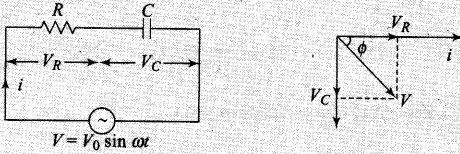
  1. Applied voltage: $\text{V}=\sqrt{\text{V}^2_\text{R}+\text{V}^2_\text{C}}$

  2. Impedance: $\text{Z}=\sqrt{\text{R}^2+\text{X}^2_\text{C}}=\sqrt{\text{R}^2+\Big(\frac{1}{\omega\text{C}}\Big)^2}$

  3. Current: $\text{i}=\text{i}_0\sin(\omega\text{t}+\phi)$

  4. Peak current: $\text{i}_0=\frac{\text{V}_0}{\text{Z}}=\frac{\text{V}_0}{\sqrt{\text{R}^2+\text{X}^2_\text{C}}}=\frac{\text{V}_0}{\sqrt{\text{R}^2+\frac{1}{4\pi^2\text{v}^2\text{C}^2}}}$

  5. Phase difference: $\phi=\tan^{-1}\frac{\text{X}_\text{C}}{\text{R}}=\tan^{-1}\frac{1}{\omega\text{CR}}$

  6. Power factor: $\cos\phi=\frac{\text{R}}{\sqrt{\text{R}^2+\text{X}^2_\text{C}}}$

  7. Leading quantity: Current.

Need a full question paper?

Generate a complete, print-ready paper with questions like this in minutes — across 16+ boards, with answer keys.

Start Generating Free

Similar questions

A convex lens of ______ focal length gives a greater magnification than lenses of _______ focal length.

Magnitude of potential difference across L. C and R in a series LCR circuit is 100 V. If resistor is re- moved, then magnitude of current in the circuit is:
The specific heat capacity of a body depends on:
  1. The heat give.
  2. The temperature raised.
  3. The mass of the body.
  4. The material of the body.
The work done to move a charge along an equipotential from A to B:
A very long bar magnet is placed with its north pole coinciding with the centre of a circular loop carrying as electric current i. The magnetic field due to the magnet at a point on the periphery of the wire is B. The radius of the loop is a. The force on the wire is:
  1. Very nearly $2\pi\text{aiB}$ perpendicular to the plane of the wire.
  2. $2\pi\text{aiB}$ in the plane of the wire.
  3. $\pi\text{aiB}$ along the magnet.
  4. Zero.

A coil having n turns and resistance R W  is connected with a galvanometer of resistance 4RΩ. This combination is moved in time t seconds from a magnetic field W1 weber to W2 weber. The induced current in the circuit is

(a)   

(b)

(c)

(d)  

The amount of substance liberated on electrodes during electrolysis when 1 coulomb of electricity is passed, is

(a) Chemical equivalent

(b) Electrochemical equivalent

(c) Equivalent weight

(d) One mol

Biot-Savart law indicates that the moving electrons (velocity v) produce a magnetic field B such that:

When   transforms to , then the number of the emitted a- and b-particles is, respectively

(a) 8α, 7β

(b) 4α, 7β

(c) 4 α, 4β

(d) 4α, 1β

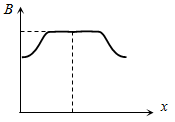
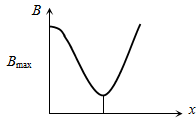
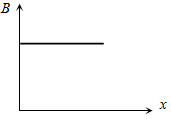
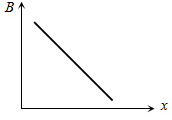
The correct curve between the magnetic induction (B) along the axis of a long solenoid due to current flow i in it and distance x from one end is

(a)

(b)

(c)

(d)