MCQ
In an atom, electrons revolve around the nucleus. This gives rise to:
- AOnly electric field.
- BOnly magnetic field.
- CBoth electric and magnetic fields.
- DNone of the above.
Explanation:
When a charge electron starts to move, electric current generates and this electric current generates magnetic field, a charge at rest also can generate electric field.
Generate a complete, print-ready paper with questions like this in minutes — across 16+ boards, with answer keys.
Unit of radioactivity is Rutherford. Its value is
|
(a) 3.7 |
(b) 3.7 |
|
(c) 1.0 |
(d) 1.0 |
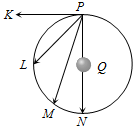
In the figure the charge Q is at the centre of the circle. Work done is maximum when another charge is taken from point P to
|
(a) K |
(b) L |
(c) M |
(d) N |
What is the modulation index of an over modulated wave
|
(a) 1 |
(b) Zero |
(c) < 1 |
(d) > 1 |
To induce an e.m.f. in a coil, the linking magnetic flux
|
(a) Must decrease |
(b) Can either increase or decrease |
|
(c) Must remain constant |
(d) Must increase |
In the circuit shown, potential difference between X and Y will be

|
(a) Zero |
(b) 20 V |
(c) 60 V |
(d) 120 V |
In the disintegration series  the values of Z and A respectively will be
|
(a) 92, 236 |
(b) 88, 230 |
(c) 90, 234 |
(d) 91, 234 |
When the current change from + 2A to – 2A in 0.05 second, an e.m.f. of 8 V is induced in a coil. The coefficient of self-induction of the coil is
|
(a) 0.1 H |
(b) 0.2 H |
(c) 0.4 H |
(d) 0.8 H |
Assertion : All the radioactive elements are ultimately converted in lead.
Reason : All the elements above lead are unstable.
|
(a) If both assertion and reason are true and the reason is the correct explanation of the assertion. |
|
(b) If both assertion and reason are true but reason is not the correct explanation of the assertion. |
|
(c) If assertion is true but reason is false. |
|
(d) If the assertion and reason both are false. |

