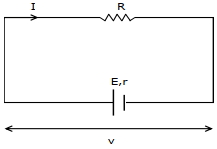
In an electric circuit, a cell of certain emf provides a potential difference of $1.25\, {V}$ across a load resistance of $5\, \Omega .$ However, it provides a potential difference of $1\, {V}$ across a load resistance of $2\, \Omega$. The $emf$ of the cell is given by $\frac{x}{10} v$. Then the value of $x$ is ..... .
JEE MAIN 2021, Medium


Download our appand get started for free
Experience the future of education. Simply download our apps or reach out to us for more information. Let's shape the future of learning together!No signup needed.*
Similar Questions
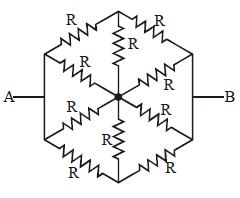
- 1Find out equivalent resistance between $A$ and $B$View Solution
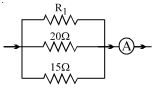
- 2In the given circuit the current flowing through the resisitance $20$ $\mathrm{ohms}$ is $0.3$ $\mathrm{ampere}$ while the ammeter reads $0.8$ $\mathrm{ampere}.$ What is the value of $R_1$? ................ $\mathrm{ohm}$View Solution
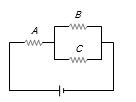
- 3Three identical resistances $A$, $B$ and $C$ are connected as shown in the given figure. The heat produced will be maximumView Solution
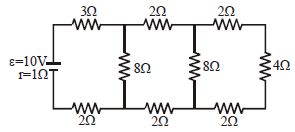
- 4In the circuit shown, the cell has $emf = 10\,V$ and internal resistance $= 1\, \Omega$ :-View Solution
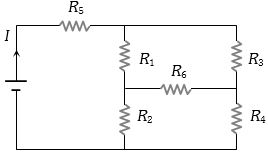
- 5In the given circuit, it is observed that the current $I$ is independent of the value of the resistance $R_6$. Then the resistance values must satisfyView Solution
- 6Water boils in an electric kettle in $15\,\min$ after switching on. If the length of the heating wire is decreased to $2/3$ of its initial value, then the same amount of water will boil with the same supply voltage in ............. $min$View Solution
- 7Two resistance wires on joining in parallel the resultant resistance is $\frac{6}{5}\,ohms$. One of the wire breaks, the effective resistance is $2\,ohms$. The resistance of the broken wire is ............ $ohm$View Solution
- 8The current flowing through a conductor connected across a source is $2\,A$ and $1.2\,A$ at $0^{\circ}\,C$ and $100^{\circ}\,C$ respectively. The current flowing through the conductor at $50^{\circ}\,C$ will be $......\times 10^2\,mA$.View Solution
- 9View SolutionTwo identical heater filaments are connected first in parallel and then in series. At the same applied voltage, the ratio of heat produced in same time for parallel to series will be:
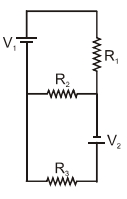
- 10Two ideal batteries of emf $V _1$ and $V _2$ and three resistances $R _1, R _2$ and $R _3$ are connected as shown in the figure.View Solution
The current in resistance $R _2$ would be zero if
$(A)$ $V_1=V_2$ and $R_1=R_2=R_3$
$(B)$ $V_1=V_2$ and $R_1=2 R_2=R_3$
$(C)$ $V_1=2 V_2$ and $2 R_1=2 R_2=R_3$
$(D)$ $2 V _1= V _2$ and $2 R _1= R _2= R _3$