Two resistance wires on joining in parallel the resultant resistance is $\frac{6}{5}\,ohms$. One of the wire breaks, the effective resistance is $2\,ohms$. The resistance of the broken wire is ............ $ohm$
Medium


Download our appand get started for free
Experience the future of education. Simply download our apps or reach out to us for more information. Let's shape the future of learning together!No signup needed.*
Similar Questions
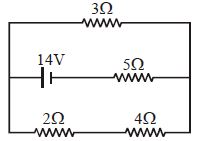
- 1Find out current in $3\,\Omega $ resistance in given circuitView Solution
- 2At what rate the potential difference between the plates of a capacitor be changed to set up a displacement current of $1\, A$ in a capacitor of $2\,\mu F$ ?View Solution
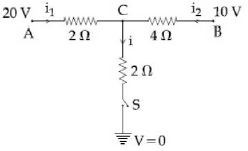
- 3When the switch $S$, in the circuit shown, is closed, then the value of current $i$ will be ................. $A$View Solution
- 4A wire of resistance $160\,\Omega$ is melted and drawn in wire of one-fourth of its length. The new resistance of the wire will be $......\Omega$View Solution
- 5A heater draws a current of $2\,A$ when connected to a $250\,V$ source. The rate of energy dissipation is ............. $W$View Solution
- 6In a wire of circular cross-section with radius $r$, free electrons travel with a drift velocity $V$ when a current $I$ flows through the wire. What is the current in another wire of half the radius and of the same material when the drift velocity is $2V$View Solution
- 7When two identical batteries of internal resistance $1 \Omega$ each are connected in series across a resistor $\mathrm{R}$, the rate of heat produced in $R$ is $J_1$. When the same batteries are connected in parallel across $R$, the rate is $\mathrm{J}_2$. If $\mathrm{J}_1=2.25 \mathrm{~J}_2$ then the value of $\mathrm{R}$ in $\Omega$ isView Solution
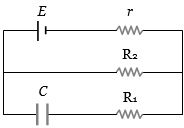
- 8In the given figure each plate of capacitance $C$ has partial value of chargeView Solution
- 9The charge flowing through a resistance $R$ varies with time as $Q = 2t - 8t^2$. The total heat produced in the resistance is (for $0 \leq t \leq \frac{1}{8}$)View Solution
- 10The total momentum of electrons in a straight wire of copper of length $1\, metre$ carrying a current of $16\, A$ isView Solution