MCQ
In an electrolyte $3.2 \times 10^{18}$ bivalent positive ions drift to the right per second while $3.6 \times 10^{18}$  monovalent negative ions drift to the left per second. Then the current is
  • A
    1.6 amp to the left
  • 1.6 amp to the right
  • C
    0.45 amp to the right
  • D
    0.45 amp to the left

Answer

Correct option: B.
1.6 amp to the right
(b) 1.6 amp to the right

Need a full question paper?

Generate a complete, print-ready paper with questions like this in minutes — across 16+ boards, with answer keys.

Start Generating Free

Similar questions

The potential differences across the resistance, capacitance and inductance are $80\,\, V, \,\,40 \,\,V$ and $100\,\, V$ respectively in an $L-C-R$ circuit. The power factor of this circuit is 
The valence of an impurity added to germanium crystal in order to convert it into a $ P-$ type semi conductor is
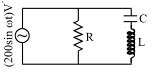
In the circuit diagram shown, $X_C = 100 \Omega$ ,$ X_L = 200 \Omega$ and $R = 100 \Omega $. The effective current through the source is.....$A$
Current $i$ is carried in a wire of length $L$. If the wire is turned into a circular coil, the maximum magnitude of torque in a given magnetic field $B$ will be
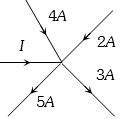
In the given current distribution what is the value of $I$ .............. $A$
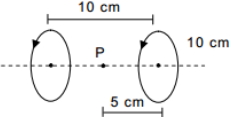
Two circular loops having same radius $[ R =10\, cm ]$ and same current $\frac{7}{2} A$ are placed along same axis as shown. If distance between their centre is $10\, cm$, find net magnetic field at of point $P.$
A bar magnet is cut into two equal halves by a plane parallel to the magnetic axis. Of the following physical quantities the one which remains unchanged is:
Which of the following spectral series in hydrogen atom give spectral line of $4860 Å$
The correct order of ionizing capacity of $\alpha ,\;\beta $ and $\gamma - $ rays is
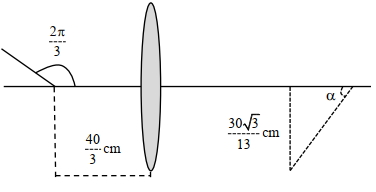
A rod of length $2 cm$ makes an angle $\frac{2 \pi}{3}$ rad with the principal axis of a thin convex lens. The lens has a focal length of $10 cm$ and is placed at a distance of $\frac{40}{3} cm$ from the object as shown in the figure. The height of the image is $\frac{30 \sqrt{3}}{13} cm$ and the angle made by it with respect to the principal axis is $\alpha$ rad. The value of $\alpha$ is $\frac{\pi}{n} rad$, where $n$ is. . . . .