Question
In an electromagnetic wave.

Answer

  1. Power is transmitted in a direction perpendicular to both the field
Explanation:
For electromagnetic waves E and B are always perpendicular to each other and perpendicular to the direction of propagation. The direction of propagation is the direction of E × B.
The direction of propagation of the wave is the direction of propagation of its energy and power.

Need a full question paper?

Generate a complete, print-ready paper with questions like this in minutes — across 16+ boards, with answer keys.
Start Generating Free

Similar questions

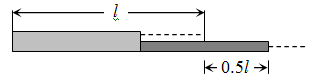
In order to quadruple the resistance of a uniform wire, a part of its length was uniformly stretched till the final length of the entire wire was $1.5$ times the original length, the part of the wire was fraction equal to
“On flowing current in a conducting wire the magnetic field produces around it.” It is a law of(a) Lenz(b) Ampere(c) Ohm(d) Maxwell
       
The wavelength of $K_\alpha\ X-$rays produced by an $X-$ray tube is $0.76 \mathring A .$ The atomic number of the anode material of the tube is
The distance between the extreme points on the periphery of the mirror is called:
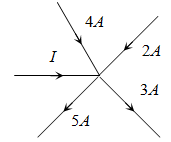
In the given current distribution what is the value of $I$
The capacitance in an oscillatory LC circuit is increased by 1%. The change in inductance required to restore its frequency of oscillation is to.
Bohr's atom model assumes(a) The nucleus is of infinite mass and is at rest(b) Electrons in a quantized orbit will not radiate energy(c) Mass of electron remains constant(d) All the above conditions


An object is released from rest. The time it takes to fall through a distance h and the speed of the object as it falls through this distance are measured with a pendulum clock. The entire apparatus is taken on the moon and the experiment is repeated:
  1. The measured times are same.
  2. The measured speeds are same.
  3. The actual times in the fall are equal.
  4. The actual speeds are equal.
Consider a capacitor$-$charging circuit. Let $Q_1$ be the charge given to the capacitor in a time interval of $10\ ms$ and $Q_2$ be the charge given in the next time interval of $10ms.$ Let $10\ mC$ charge be deposited in time interval $t_1$ and another $10\ mC$ charge be deposited in the next time interval $t_2.$
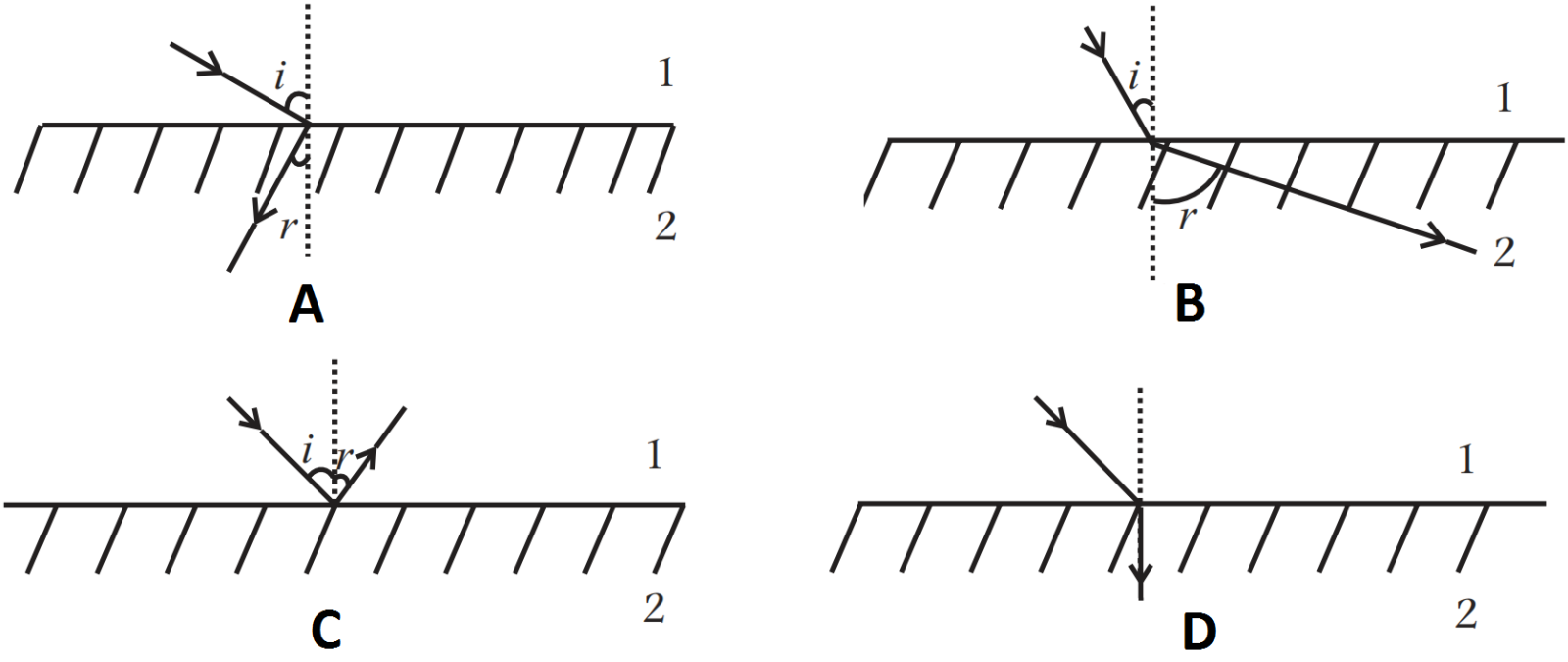
There are certain material developed in laboratories which have a negative refractive index (Fig). A ray incident from air (medium 1) into such a medium (medium 2) shall follow a path given by: