MCQ
In an elevator moving vertically up with an acceleration 'g', the force exerted on the floor by a passenger of mass M is:
  • A
    Mg
  • B
    $\frac{1}{2}\text{Mg}$
  • C
    zero
  • D
    2Mg

Answer

  1. 2Mg

Explanation:

Force exerted by the passenger on floor

= R = M(g + a) = M(g + g) = 2Mg

Need a full question paper?

Generate a complete, print-ready paper with questions like this in minutes — across 16+ boards, with answer keys.
Start Generating Free

Similar questions

A smooth sphere $A$ is moving on a frictionless horizontal plane with angular speed $\omega $ and center of mass with velocity $v$. It collides elastically and head-on with an identical sphere $B$ at rest. Neglect friction everywhere. After the collision, their angular speeds are ${\omega _A}$ and ${\omega _B}$ respectively. Then
A stone is allowed to fall freely from rest. The ratio of the time taken to fall through the first meter and the second meter distance is:
For a moving body at any instant of time
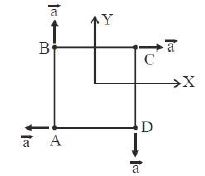
Four particles $A, B, C$ and $D$ with masses $m_A=m, m_B=2m, m_C=3m$ and $m_D=4m$ are at the corners of a square. They have accelerations of equal magnitude with directions as shown. The acceleration of the centre of mass of the particles is
Internal forces acting within a system of particles can alter
If the unit of length and force be increased four times, then the unit of energy is
$Assertion :$ For higher temperature the peak emission wavelength of a blackbody shifts to lower wavelengths.

$Reason :$ Peak emission wavelengths of a black body is proportional to the fourth-power of temperature.

Assertion $(A)$: In an elastic collision between two bides, the relative speed of the bodies after collision is equal to the relative speed before the collision.

Reason $(R)$: In elastic collision, the linear momentum of the system is conserved.

A light wave can travel:
  1. In vacuum.
  2. In vacuum only.
  3. In a material medium.
  4. In a material medium only
A ball is thrown at an angle $\theta $ and another ball is thrown at an angle $(90^o -\theta )$ with the horizontal from the same point with same speed $40\,ms^{-1}$. The second ball reaches $50\,m$ higher than the first ball. Find their individual heights?