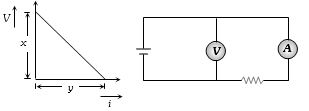
In an experiment, a graph was plotted of the potential difference $V$ between the terminals of a cell against the circuit current $i$ by varying load rheostat. Internal conductance of the cell is given by
Medium


Download our appand get started for free
Experience the future of education. Simply download our apps or reach out to us for more information. Let's shape the future of learning together!No signup needed.*
Similar Questions
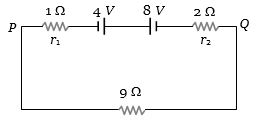
- 1Two batteries of $e.m.f.$ $4\,V$ and $8 \,V$ with internal resistances $1\, \Omega$ and $2\,\Omega$ are connected in a circuit with a resistance of $9 \,\Omega$ as shown in figure. The current and potential difference between the points $P$ and $Q$ areView Solution
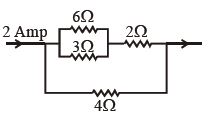
- 2In the adjoining circuit, the potential difference across $3\,\,\Omega $ is ................ $\mathrm{V}$View Solution
- 3When a resistor of $11 \,\Omega$ is connected in series with an electric cell, the current flowing in it is $0.5\, A$. Instead, when a resistor of $5 \,\Omega$ is connected to the same electric cell in series, the current increases by $0.4\, A$. The internal resistance of the cell is ................ $\Omega$View Solution
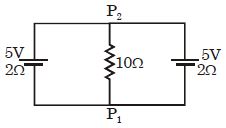
- 4Find the current in the $10\, \Omega$ resistanceView Solution
- 5A conducting wire of length $ l$ area of cross-section $A$ and electric resistivity $\rho$ is connected between the terminals of a battery. $A$ potential difference $V$ is developed between its ends, causing an electric current.If the length of the wire of the same material is doubled and the area of cross-section is halved, the resultant current would beView Solution
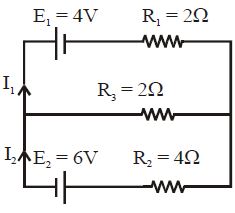
- 6In the circuit shown : $E_1 = 4.0\ V, R_1 = 2 \ \Omega,$$ E_2 = 6.0\ V, R_2 = 4\ \Omega$ and $R_3 = 2\ \Omega.$ The current $I_1$ is : ................ $A$View Solution
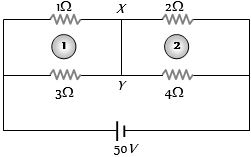
- 7Current through wire $XY$ of circuit shown is ................ $A$View Solution
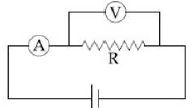
- 8The actual value of resistance $R$, shown in the figure is $30\,\Omega $. This is measured in an experiment as shown using the standard formula $R = \frac{V}{I}$ where $V$ and $I$ are the readings of the voltmeter and ammeter, respectively. If the measured value of $R$ is $5\%$ less, then the internal resistance of the voltmeter is ................. $\Omega$View Solution
- 9A current of $5\; {A}$ is passing through a non-linear magnesium wire of cross-section $0.04\; {m}^{2}$. At every point the direction of current density is at an angle of $60^{\circ}$ with the unit vector of area of cross-section. The magnitude of electric field at every point of the conductor is ....${V} / {m}$ (Resistivity of magnesium is $\rho=44 \times 10^{-8}\, \Omega m$)View Solution
- 10A student measures the terminal potential difference $(V)$ of a cell $($ of $emf \;\varepsilon $ and internal resistance $r)$ as a function of the current $(I)$ flowing through it. The slope, and intercept, of the graph between $V$ and $I$, then, respectively, equalView Solution