MCQ
In an experiment four quantities $a, b, c$ and $d $ are measured with percentage error $1\%, 2\%, 3\%$ and $4\%$ respectively. Quantity $P$ is calculated as follows $P = \frac{{{a^3}{b^2}}}{{cd}}$. $ \%$ error in $P$ is ........ $\%$
  • $14$
  • B
    $10$
  • C
    $7$
  • D
    $4$

Answer

Correct option: A.
$14$
a
As, $P = \frac{{{a^3}{b^2}}}{{cd}}$
$ \% $, error, in, $P$, is
$\frac{{\Delta P}}{P} \times 100 = \left[ {3\left( {\frac{{\Delta a}}{a}} \right) + 2\left( {\frac{{\Delta b}}{b}} \right) + \frac{{\Delta c}}{c} + \frac{{\Delta d}}{d}} \right] \times 100$
$ = 3\left[ {3 \times 1\%  + 2 \times 2\%  + 3\%  + 4\% } \right] = 14\% $
 

Need a full question paper?

Generate a complete, print-ready paper with questions like this in minutes — across 16+ boards, with answer keys.

Start Generating Free

Similar questions

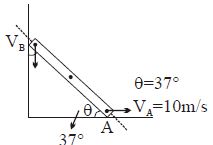
Find $V_B = ?$
If the radius of a planet is $R$ and its density is $\rho $, the escape velocity from its surface will be
A particle is acted simultaneously by mutually perpendicular simple hormonic motions $\text{x}=\text{a}\cos\omega\text{t}\ \text{and}\ \text{y}=\text{a}\sin\omega\text{t}.$ The trajectory of motion of the particle will be:
    Two particles are projected in air with speed vo at angles $\theta_1$ and $\theta_2$ (both acute) to the horizontal, respectively. If the height reached by the first particle is greater than that of the second, then tick the right choices
    1. angle of projection: q1 > q2
    2. time of flight: T1 > T2
    3. horizontal range: R1 > R2
    4. total energy: U1 > U2
    A parachutist after bailing out falls 50m without friction. When parachute opens, it decelerate at 2m/ s2. He reaches the ground with a speed of 3m/ s. At what height, did he bail out nearly.
    A spaceship orbits around a planet at a height of $20\,km$ from its surface. Assuming that only gravitational field of the plant acts on the spaceship. What will be the number of complete revolutions made by the spaceship in $24\,hours$ around the plane? [Given: Mass of plane $= 8 \times 10^{22}\,kg,$ Radius of planet $= 2\times 10^6\,m,$ Gravitational constant $G = 6.67\times 10^{-11}\,Mn^2/kg^2$ ]
    Two trains, each $50 \,m$ long are travelling in opposite direction with velocity $10 \,m/s$ and $15 \,m/s$. The time of crossing is...........$s$
    An object is thrown vertically upwards. At its maximum height, which of the following quantity becomes zero?
    A space craft of mass $M$ is moving with velocity $V$ and suddenly explodes into two pieces. A part of it of mass m becomes at rest, then the velocity of other part will be
    A block is moving on an inclined plane making an angle $45^{\circ}$ with the horizontal and the coefficient of friction is $\mu$. The force required to just push it up the inclined plane is $3$ times the force required to just prevent it from sliding down. If we define $N=10 \ \mu$, then $N$ is