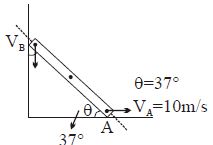
MCQ
Find $V_B = ?$
  • A
    $V_A\,\,tan\,\,\theta $
  • B
    $V_A\,\,sec^2\,\,\theta $
  • C
    $V_A\,\,cosec\,\,\theta $
  • $V_A\,\,cot\,\,\theta $

Answer

Correct option: D.
$V_A\,\,cot\,\,\theta $
d

Need a full question paper?

Generate a complete, print-ready paper with questions like this in minutes — across 16+ boards, with answer keys.

Start Generating Free

Similar questions

A rod of length $3\, m$ and its mass per unit length is directly proportional to the distance $x$ from its one end. The center of gravity of the rod from that end will be at ........ $ m$
A satellite is orbiting just above the surface of a planet of average density $\rho$ with period T. If G is the universal gravitational constant, the quantity $\text{T}^2\rho$ is equal to:
Projection of vector $\vec A$ on $\vec B$ is
Two billiard balls of mass $0.05\,kg$ each moving in opposite directions with $10\,ms ^{-1}$ collide and rebound with the same speed. If the time duration of contact is $t=0.005\,s$, then $\dots N$is the force exerted on the ball due to each other.
A simple pendulum suspended from the roof of a lift oscillates with frequency v when the lift is at rest. If the lift falls freely under gravity, its frequency of oscillations becomes:
The equation of motion of a particle of mass $1\,g$ is $\frac{{{d^2}x}}{{d{t^2}}} + {\pi ^2}x = 0$ where $x$ is displacement (in $m$ ) from mean position. The frequency of oscillation is .... $s$ (in $Hz$ )
A mixture of ideal gases has $2$ moles of He, $4$ moles of oxygen and $1$ mole of ozone at absolute temperature $T$. The internal energy of mixture is ............. $RT$
The distance covered by a body of mass $5\,g$ having linear momentum $0.3\,kg\,m / s$ in $5\,s$ is $..........\,m$
$Assertion :$ A bubble comes from the bottom of a lake to the top.
$Reason :$ Its radius increases.
Let $\overrightarrow{\text{E}}$ and $\overrightarrow{\text{B}}$ denote electric and magnetic fields in a frame S and $\overrightarrow{\text{E}}$ and $\overrightarrow{\text{B}}$ in another frame S moving with respect to S at a velocity $\overrightarrow{\text{v}}.$ Two of the following equations are wrong. Identify them.

  1. $\text{B}_\text{y},=\text{B}_\text{y}+\frac{\text{vE}_\text{z}}{\text{c}^2}$

  2. $\text{E}_\text{y},=\text{E}_\text{y}+\frac{\text{vB}_\text{z}}{\text{c}^2}$

  3. $\text{B}'_\text{y}=\text{B}_\text{y}+\text{v}\text{E}_\text{z}$

  4. $\text{E}'_\text{y}=\text{E}_\text{y}+\text{vB}_\text{z}$