MCQ
In an inelastic collision,
  • A
    the velocity of both the particles may be same after the collision
  • B
    kinetic energy is not conserved
  • C
    linear momentum of the system is conserved.
  • All of the above

Answer

Correct option: D.
All of the above
d
In case of perfectly inelastic collision,

Final velocities of both the body is same

But, when the collision is not perfectly inelastic the velocities differ.

Thus, the final velocity of the bodies may or may not be same.

Also, there is a loss of kinetic energy during an inelastic collision.

thus, kinetic energy is not conserved and velocity of separation will be less than

velocity of approach.

A collision, let it be elastic or inelastic has always its momentum conserved and

is given by,

$m_1 u_1+m_2 u_2=m_1 v_1+m_2 v_2$

Thus, linear momentum of the system is conserved

Need a full question paper?

Generate a complete, print-ready paper with questions like this in minutes — across 16+ boards, with answer keys.

Start Generating Free

Similar questions

A body of mass M is kept on a rough horizontal surface (friction coefficient = $\mu$). A person is trying to pull the body by applying a horizontal force but the body is not moving. The force by the surface on A is F, where:

  1. $\text{F = Mg}$

  2. $\text{F}=\mu\text{Mg}$

  3. $\text{Mg}\leq\text{F}\leq\text{Mg}\sqrt{1+\mu^2}$

  4. $\text{Mg}\geq\text{F}\geq\text{Mg}\sqrt{1-\mu^2}.$
If the radius of the earth shrinks by $1.5\%$ (mass remaining same), then the value of acceleration due to gravity changes by ....... $\%$.
A copper rod of length $l_1$ and an iron rod of length $l_2$ are always maintained at the same common temperature $T$. If the difference $(l_2 -l_1)$ is $15\,cm$ and is independent of the value of $T,$ the $l_1$ and $l_2$ have the values (given the linear coefficient of expansion for copper and iron are $2.0 \times 10^{-6}\,C^{-1}$ and $1.0\times10^{-6}\,C^{ -1}$  respectively)
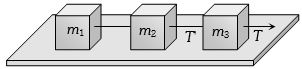
Three blocks of masses ${m_1},\,{m_2}$ and ${m_3}$ are connected by massless strings as shown on a frictionless table. They are pulled with a force ${T_3} = 40\,N$. If ${m_1} = 10\,kg,\,{m_2} = 6\,kg$ and ${m_3} = 4\,kg$, the tension ${T_2}$ will be ........ $N$
A parallel-plate capacitor has plates of unequal area. The larger plate is connected to the positive terminal of the battery and the smaller plate to its negative terminal. Let Q+ and Q- be the charges appearing on the positive and negative plates respectively:
  1. Q+ > Q-
  2. Q= Q-
  3. Q+ < Q-
  4. The information is not sufficient to decide the relation between Q+ and Q-.
An ideal gas is subjected to an isothermal expansion such that its volume changes from $V_i$ to $V_f$ and pressure from $P_i$ to $P_f$. The work done on the gas is :
The resultant of two vectors at an angle $150^{\circ}$ is $10$ units and is perpendicular to one vector. The magnitude of the smaller vector is ....... units
A spectrometer gives the following reading when used to measure the angle of a prism. 

Main scale reading : $58.5$ degree

Vernier scale reading : $09$ divisions

Given that $1$ division on main scale corresponds to $0 .5$ degree. Total divisions on the Vernier scale is $30$ and match with $29$ divisions of the main scale. The angle of the prism from the above data ....... $degree$

If $\left| {{{\vec v}_1} + {{\vec v}_2}} \right| = \left| {{{\vec v}_1} - {{\vec v}_2}} \right|$ and ${{{\vec v}_1}}$ and ${{{\vec v}_2}}$ are finite, then
A particle moves on a straight line with a uniform velocity. The angular momentum of the particle is: