Question

In an interference experiment, the spacing between successive maxima or minima is  (Where the symbols have their usual meanings)

(a)        

(b)  

(c)        

(d)  

Answer

(b)  

Need a full question paper?

Generate a complete, print-ready paper with questions like this in minutes — across 16+ boards, with answer keys.

Start Generating Free

Similar questions

Consider a wire carrying a steady current, I placed in a uniform magnetic field B perpendicular to its length. Consider the charges inside the wire. It is known that magnetic forces do no work. This implies that:
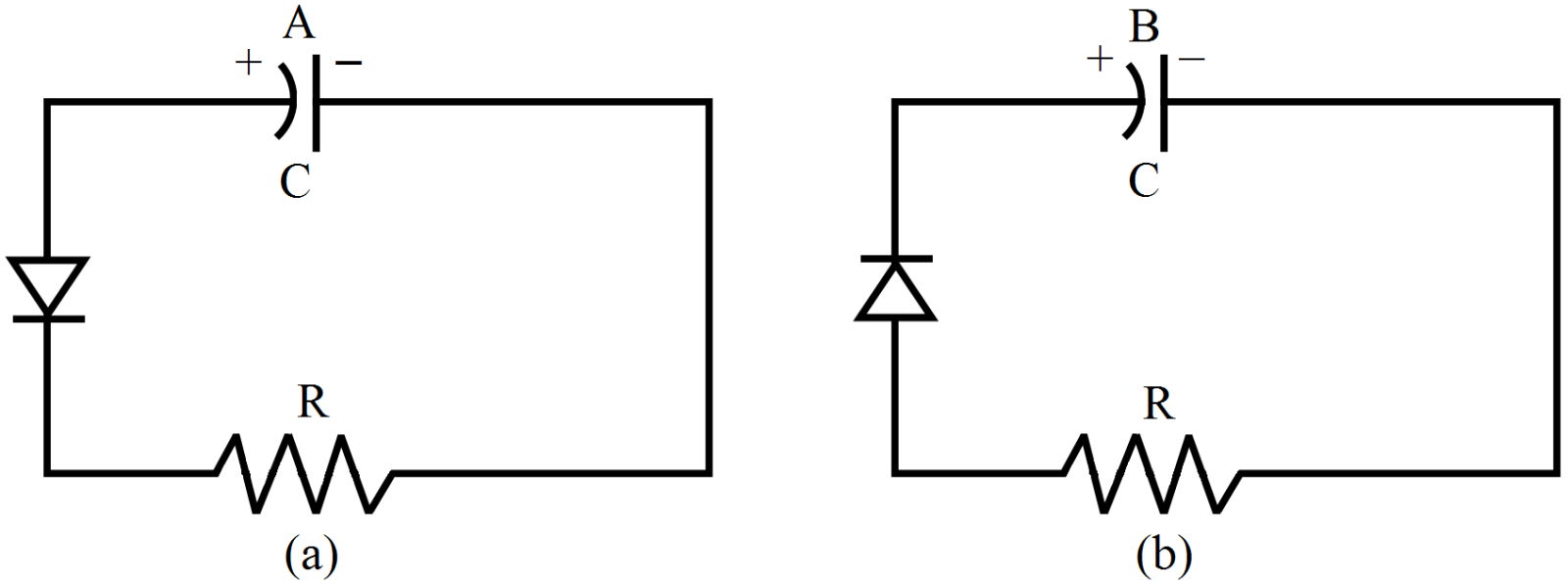
Two identical capacitors A and B are charged to the same potential V and are connected in two circuits at t = 0 as shown in figure. The charges on the capahltors at a time t = CR are, respectively:

If the mass of neutron =1.7×10⁻²⁷kg . Then the de broglie wavelength of neutron of energy 3eV is:
On applying an external magnetic field, to a ferromagnetic substance domains.

The tangent galvanometer, when connected in series with a standard resistance can be used as

(a) An ammeter

(b) A voltmeter

(c) A wattmeter

(d) Both an ammeter and a voltmeter

X-ray beam can be deflected:
Biot-Savart law indicates that the moving electrons (velocity v) produce a magnetic field B such that:

The de-Broglie wavelength l

(a) is proportional to mass

(b) is proportional to impulse

(c) Inversely proportional to impulse

(d) does not depend on impulse

Consider a planet in some solar system which has a mass double the mass of the earth and density equal to the average density of the earth. An object weighing W on the earth will weight.

  1. W

  2. 2W

  3. $\frac{\text{W}}{2}$

  4. $2^{\frac{1}{3}}$ W at the planet.

At what distance from a convex lens of focal length 30 cm, an object should be placed so that the size of the image be 1/2 of the object

(a) 30 cm

(b) 60 cm

(c) 15 cm

(d) 90 cm