MCQ
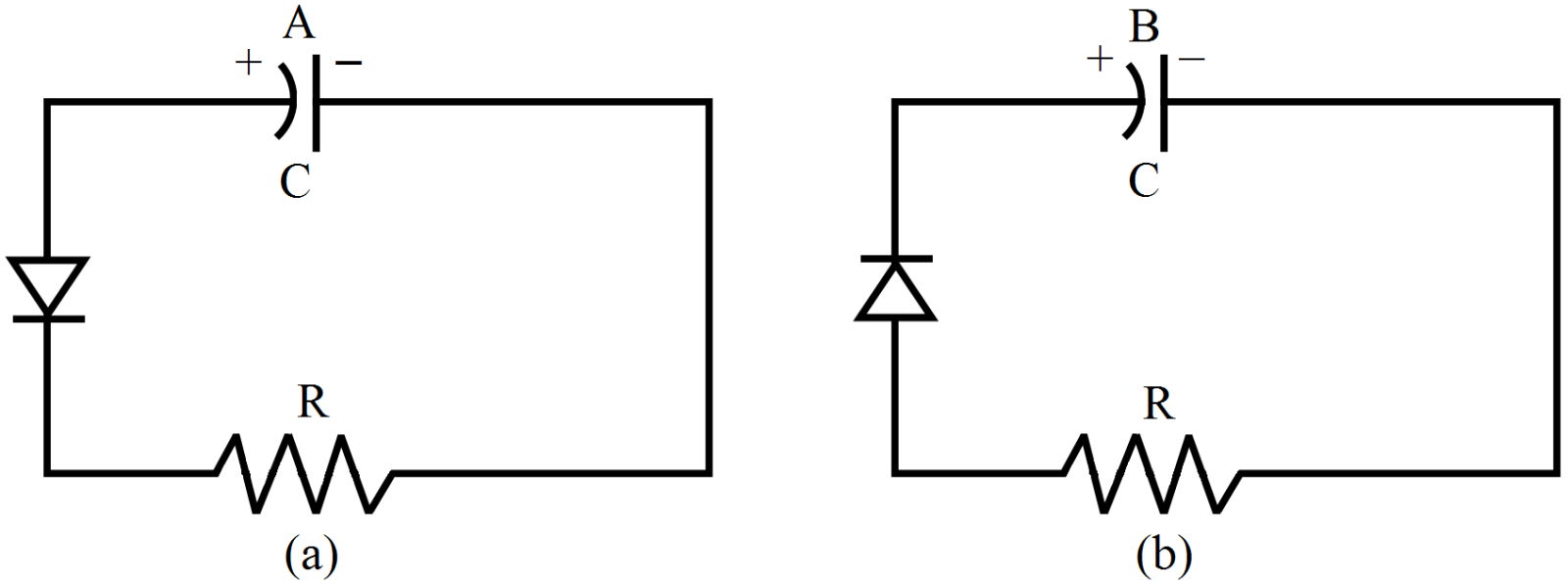
Two identical capacitors A and B are charged to the same potential V and are connected in two circuits at t = 0 as shown in figure. The charges on the capahltors at a time t = CR are, respectively:
  • A
    $\text{VC}, \text{VC}$
  • B
    $\frac{\text{VC}}{\text{e}}, \text{VC}$
  • C
    $\text{VC}, \frac{\text{VC}}{\text{e}}$
  • D
    $\frac{\text{VC}}{\text{e}}, \frac{\text{VC}}{\text{e}}$
Answer

  1. $\frac{\text{VC}}{\text{e}}, \text{VC}$

Explanation:

In circuit (a), the diode is forward biassed. So, it offers negligible resistance to the flow of current and can thus be replaced by a short circuit. Now, the capacitor charge will leak through the resistance and decay exponentially with time.

Capacitor charge $=\frac{\text{VC}}{\text{e}}$

In circuit (b), the diode is reverse biassed. So, it offers infinite resistance to the current flow and can thus be replaced by an open circuit. As the circuit is open now, no current can flow across the resistance. So, the charge in the capacitor cannot leak through the resistor.

Capacitor charge = VC

Need a full question paper?

Generate a complete, print-ready paper with questions like this in minutes — across 16+ boards, with answer keys.

Start Generating Free

Similar questions

If two bulbs of wattage 25 and 100 respectively each rated at 220 volt are connected in series with the supply of 440 volt, then which bulbs will fuse

(a) 100 watt bulb

(b) 25 watt bulb

(c) None of them

(d) Both of them

Laser beams are used to measure long distance because

(a) They are monochromatic

(b) They are highly polarised

(c) They are coherent

(d) They have high degree of parallelism

A sky wave with a frequency 55 MHz is incident on D-region of earth's atmosphere at 45o. The angle of refraction is (electron density for D-region is 400 electron/cm3)

(a) 60°

(b) 45°

(c) 30°

(d) 15°

Three semi-conductors are arranged in the increasing order of their energy gap as follows. The correct  arrangement is

(a) Tellurium, germanium, silicon

(b) Tellurium, silicon, germanium

(c) Silicon, germanium, tellurium

(d) Silicon, tellurium, germanium

The maximum electric field that a dielectric medium can withstand without break-down is called its:

In a P-type semi-conductor, germanium is dopped with

(a) Gallium

(b) Boron

(c) Aluminium

(d) All of these

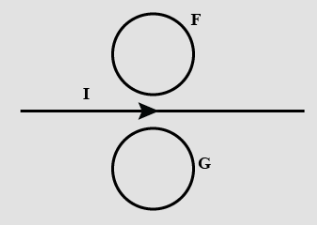
Two conducting circular loops F and G are kept in a plane on either side of a straight current-carrying wire as shown in the figure below.
If the current in the wire decreases in magnitude, the induced current in the loops will be:

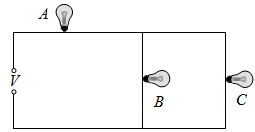
Assertion   : In the given circuit if lamp B or C fuses then light emitted by lamp A decreases.

Reason      : Voltage on A decreases.


(a) If both assertion and reason are true and the reason is the correct explanation of the assertion.

(b) If both assertion and reason are true but reason is not the correct explanation of the assertion.

(c) If assertion is true but reason is false.

(d) If the assertion and reason both are false.

The truth table shown in figure is for

A

0

0

1

1

B

0

1

0

1

y

1

0

0

1

(a) XOR

(b) AND

(c) XNOR

(d) OR

When a lens is dipped into the water its focal length :