Question
In an intrinsic semiconductor, conductivity is:

Answer

  1. Low at room temperature
Explanation:
In intrinsic semiconductors, n = p. Hence, at room temperature, no free electrons are available for conduction. If the temperature is increased, the covalent bonds will break and electrons will be freed, each electron will leave behind a hole and capture a new hole the process will continued and charge flows through intrinsic semiconductor.
Thus, its conductivity increases with temperature. Hence, in intrinsic semiconductor conductivity is low at room temperature.

Need a full question paper?

Generate a complete, print-ready paper with questions like this in minutes — across 16+ boards, with answer keys.
Start Generating Free

Similar questions

The momentum of a photon in an $X-$ray beam of  $10^{-10}$  metre wavelength is
Between the primary and secondary rainbows, there is a dark band known as Alexandar’s dark band. This is because:
A wire of length $1 m$ is moving at a speed of $2 \mathrm{~ms}^{-1}$ perpendicular to its length and a homogeneous magnetic field of $0.5 T .$ The ends of the wire are joined to a circuit of resistance $6 \Omega$. The rate at which work is being done to keep the wire moving at constant speed is
In Bohr model of hydrogen atom, let P.E. represents potential energy and T.E. represents the total energy. In going to a higher level:
The threshold wavelength for photoelectric effect of a metal is 6500 Å. The work function of the metal is approximately(a) 2 eV(b) 1 eV(c) 0.1 eV  (d) 3 eV
       
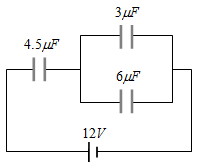
In the circuit shown in the figure, the potential difference across the $4.5\ mF$ capacitor is
A vibration magnetometer consists of two identical bar magnets placed one over the other such that they are perpendicular and bisect each other. The time period of oscillation in a horizontal magnetic field is $2^{5 / 4}$ seconds. One of the magnets is removed and if the other magnet oscillates in the same field, then the time period in seconds is
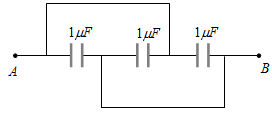
The equivalent capacitance in the circuit between $A$ and $B$ will be
A vertical straight conductor carries a current vertically upwards. A point P lies to the east of it at a small distance and another point Q lies to the west at the same distance. The magnetic field at P is(a) Greater than at Q(b) Same as at Q(c) Less than at Q(d) Greater or less than at Q depending upon the strength of the current


A $10$ metre wire kept in east$-$west falling with velocity $5 \mathrm{~m} / \mathrm{sec}$ perpendicular to the field $0.3 \times 10^{-4} \mathrm{wb} / \mathrm{m}^2-$ The induced $e.m.f.$ across the terminal will be