MCQ
In an isothermal expansion
  • A
    Internal energy of the gas increases
  • B
    Internal energy of the gas decreases
  • Internal energy remains unchanged
  • D
    Average kinetic energy of gas molecule decreases

Answer

Correct option: C.
Internal energy remains unchanged
c
(c) In isothermal expansion temperature remains constant, hence no change in internal energy.

Need a full question paper?

Generate a complete, print-ready paper with questions like this in minutes — across 16+ boards, with answer keys.
Start Generating Free

Similar questions

A body is moving with a uniform acceleration covers $40\,m$ in the first $4\,s$ and $120\,m$ in next $4\,s.$ Its initial velocity and acceleration are
Apiece of steel has a weight $W$ in air, $W_1$ when completely immersed in water and $W_2$ when completely immersed in an unknown liquid. The relative density (specific gravity)of liquid is
A body is moving on a circle of radius $80 \,m$ with a speed $20 \,m / s$ which is decreasing at the rate $5 \,m / s ^2$ at an instant. The angle made by its acceleration with its velocity is ..........
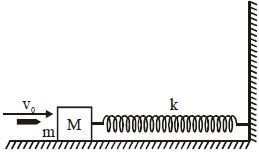
A bullet of mass $m$ strikes a block of mass $M$ connected to a light spring of stiffness $k,$ with a speed $v_0.$ If the bullet gets embedded in the block then, the maximum compression in the spring is
A ball $P$  collides with another identical ball  $Q$  at rest. For what value of coefficient of restitution $e$ , the  velocity of ball  $Q$  become two times that of ball  $P$  after collision
A body takes just twice the time as long to slide down a plane inclined at $30^o$ to the horizontal as if the plane were frictionless. The coefficient of friction between the body and the plane is
A block of mass $m$ attached to massless spring is performing oscillatory motion of amplitude $'A'$ on a frictionless horizontal plane. If half of the mass of the block breaks off when it is passing through its equilibrium point, the amplitude of oscillation for the remaining system become $fA.$ The value of $f$ is
A particle $P$ is moving in a circle of radius $'a'$ with a uniform speed $v$ . $C$ is the centre of the circle and $AB$ is a diameter. When passing through $B$ the angular velocity of $P$ about $A$ and $C$ are in the ratio 
Two bodies $A$ and $B$ of same mass, area and surface finish with specific heats $S_A$ and $S_B\left(S_A > S_B\right)$ are allowed to cool for given temperature range. Temperature varies with time as ..........
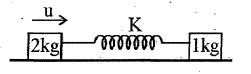
Two blocks of mass $2\ kg$ and $1\ kg$ are connected by an ideal spring on a rough surface. The spring in unstreched. Spring constant is $8\ N/m$ . Coefficient of friction is  $μ = 0.8$ . Now block $2\ kg$ is imparted a velocity $u$ towards $1\ kg$ block. Find the maximum value of velocity $'u'$ of block $2\ kg$ such that block of $1\ kg$ mass never move is