MCQ
In an LPP, if the objective function $z=a x+$ by has the same maximum value on two corner points of the feasible region, then the number of points at which $z_{\max }$ occurs is
  • A
    $0$
  • B
    2
  • C
    finite
  • D
    infinite

Answer

In an LPP, if the objective function $z=a x+b y$ has the same maximum value on two corner points of the feasible region, then the number of points at which $z_{\max }$ occurs is infinite.

Need a full question paper?

Generate a complete, print-ready paper with questions like this in minutes — across 16+ boards, with answer keys.

Start Generating Free

Similar questions

The equation of line $x + y + z -1 = 0 = 4x + y -2z + 2$ written in the symmetrical form is where

$(A)$ $ \equiv \frac{{x + 1}}{1} = \frac{{y - 2}}{{ - 2}} = \frac{{z - 0}}{1}$

$(B)$ $ \equiv \frac{x}{1} = \frac{y}{{ - 2}} = \frac{{z - 1}}{1}$

$(C)$ $ \frac{{x + 1/2}}{1} = \frac{{y - 1}}{{ - 2}} = \frac{{z - 1/2}}{1}$
The degree of differential equation $\sqrt{1+\left(\frac{d y}{d x}\right)^2}=$ $a\left(\frac{d^2 y}{d x^2}\right)^{\frac{1}{3}}:$
A bag containe 5 black, 4white balls and 3 red balls. if a ball is selected randomwise, the probability that it is black or red ball is,
  1. $\frac{1}{3}$
  2. $\frac{1}{4}$
  3. $\frac{5}{12}$
  4. $\frac{2}{3}$
The solution of the differential equation ${\cos ^2}x\frac{{{d^2}y}}{{d{x^2}}} = 1$ is
The function $f(x) = {x^3} - 6{x^2} + ax + b$ satisfy the conditions of Rolle's theorem in $[1, 3]. $ The values of  $a $ and $ b $ are
A and B are two students. Their chances of solving a problem correctly are $\frac{1}{3}$ and $\frac{1}{4}$ respectively. If the probability of their making common error is $\frac{1}{20}$ and they obtain the same answer, then the probability of their answer to be correct is.
  1. $\frac{10}{13}$
  2. $\frac{13}{120}$
  3. $\frac{1}{40}$
  4. $\frac{1}{12}$
In a square matrix $A$ of order $3, a_{i i}'s$ are the sum of the roots of the equation $x^2 - (a + b)x + ab= 0$; $a_{i , i + 1}'s$ are the product of the roots, $a_{i , i - 1}'s$ are all unity and the rest of the elements are all zero. The value of the det. $(A)$ is equal to
Let $y=y(x)$ be the solution of the differential equation $x \log _e x \frac{d y}{d x}+y=x^2 \log _e x,(x > 1)$. If $y (2)=2$, then $y ( e )$ is equal to
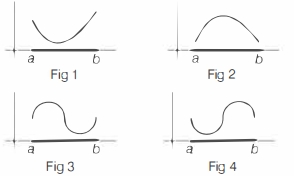
The following figure shows the graph of a differentiable function $y=f(x)$ on the interval $[a, b]$ (not containing $0$ ).  $FIGURE$  Let $g(x)=\frac{f(x)}{x}$. Which of the following is a possible graph of $y=g(x) ?$
Write the number of points where f(x) = |x + 2| + |x - 3| is not differentiable:
  1. 2
  2. 0
  3. 1
  4. 3