MCQ
In an LPP, if the objective function $Z=a x+b y$ has the same maximum value on two corner points of the feasible region, then the number of points at which $Z_{\max }$ occurs is
  • A
    0
  • B
    2
  • C
    finite
  • infinite

Answer

Correct option: D.
infinite
(d) : In an LPP, if the objective function $Z=a x+b y$ has the same maximum value on two corner points of the feasible region, then the number of points at which $Z_{\max }$ occurs is infinite.

Need a full question paper?

Generate a complete, print-ready paper with questions like this in minutes — across 16+ boards, with answer keys.
Start Generating Free

Similar questions

The position vectors of four points  $ P, Q, R, S$  are $2a + 4c,\,$ $5a + 3\sqrt 3 \,b + 4c,$ $ - 2\sqrt 3 b + c$ and $2a + c$ respectively, then
Let $D _{ k }=\left|\begin{array}{ccc}1 & 2 k & 2 k -1 \\ n & n ^2+ n +2 & n ^2 \\ n & n ^2+ n & n ^2+ n +2\end{array}\right|$. If $\sum \limits_{ k =1}^n$ $D _{ k }=96$, then $n$ is equal to
If $\vec{a}, \vec{b}$ and $(\vec{a}+\vec{b})$ are all unit vectors and $\theta$ is the angle between $\vec{a}$ and $\vec{b}$, then the value of $\theta$ is:
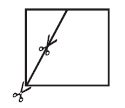
Consider a square of side $2\ cm$ . It is cut from one of its corner as shown in adjacent figure. Maximum value of sum of the perimeters of two plane figures thus formed is
The solution of differential equation $\frac{\text{dy}}{\text{dx}}-3\text{y}=\sin2\text{x}$ is:
It is given that $X\left[\begin{array}{cc}3 & 2 \\ 1 & -1\end{array}\right]=\left[\begin{array}{ll}4 & 1 \\ 2 & 3\end{array}\right]$. Then matrix $X$ is :
Which of the following expressions are meaningful
Which of the following statement is true for the function $f(x)\, = \,\,\,\left[ \begin{array}{l}\sqrt x \,\,\,\,\,\,\,\,\,\,\,\,\,\,x\,\, \ge \,1\\{x^3}\,\,\,\,\,\,\,\,\,\,\,\,\,\,\,0\, \le x\, \le 1\\\frac{{{x^3}}}{3}\, - \,4x\,\,\,\,\,x\,\, < \,0\end{array} \right.$
Let $f: R \rightarrow R$ satisfy $f(x+y)=2^{x} f(y)+4^{y} f(x), \forall x$, $y \in R$. If $f(2)=3$, then $14 \cdot \frac{f^{\prime}(4)}{f^{\prime}(2)}$ is equal to
If O is the origin, OP = 3 with direction ratios proportional to -1, 2, -2 then the coordinates of P are: