Question
In beta decay, an electron (or a positron) is emitted by a nucleus. Does the remaining atom get oppositely charged?

Answer

In beta decay, a neutron from the nucleus is converted to a proton releasing an electron and an antineutrino or a proton is converted to a neutron releasing a positron and a neutrino.
$\beta^-\text{decay:}\text{ n}\rightarrow\text{p + e + }\vec{\text{v}}$
$\beta^+\text{decay:}\text{ p}\rightarrow\text{n + e}^+ + \text{v}$
Since the number of valence electrons present in the parent atom do not change, the remaining atom does not get oppositely charged. Instead, due to a change in the atomic number, there's a formation of a new element.

Need a full question paper?

Generate a complete, print-ready paper with questions like this in minutes — across 16+ boards, with answer keys.

Start Generating Free

Similar questions

In an agricultural experiment, a solution containing 1 mole of a radioactive material $\Big(\text{t}_{\frac{1}{2}}=14.3\text{ days}\Big)$ was injected into the roots of a plant. The plant was allowed 70 hours to settle down and then activity was measured in its fruit. If the activity measured was $1\mu\text{Ci},$ what per cent of activity is transmitted from the root to the fruit in steady state?
a. Derive the expression for the electric potential due to an electric dipole at a point on its axial line.
b. Depict the equipotential surfaces due to an electric dipole.
A voltmeter coil has resistance $50.0\Omega$ and a resistor of $1.15\text{k}\Omega$ is connected in series. It can read potential differences up to 12 volts. If this same coil is used to construct an ammeter that can measure currents up to 2.0A, what should be the resistance of the shunt used?
  1. In the explanation of photo electric effect, we asssume one photon of frequency ν collides with an electron and transfers its energy. This leads to the equation for the maximum energy Emax of the emitted electron as,

$\text{E}_\text{max}=\text{hv}-\phi_0$

where $\phi_0$ is the work function of the metal. If an electron absorbs 2 photons (each of frequency ν ) what will be the maximum energy for the emitted electron?
  1. Why is this fact (two photon absorption) not taken into consideration in our discussion of the stopping potential?
A parallel-plate capacitor has plate area 25.0cm2 and a separation of 2.00mm between the plates. The capacitor is connected to a battery of 12.0V:
  1. Find the charge on the capacitor.
  2. The plate separation is decreased to 1.00mm. Find the extra charge given by the battery to the positive plate.
The work function of caesium metal is 2.14 eV. When light of frequency 6 × 1014 Hz is incident on the metal surface, photoemission of electrons occurs. What is the
  1. Maximum kinetic energy of the emitted electrons,
  2. Stopping potential, and
  3. Maximum speed of the emitted photoelectrons?
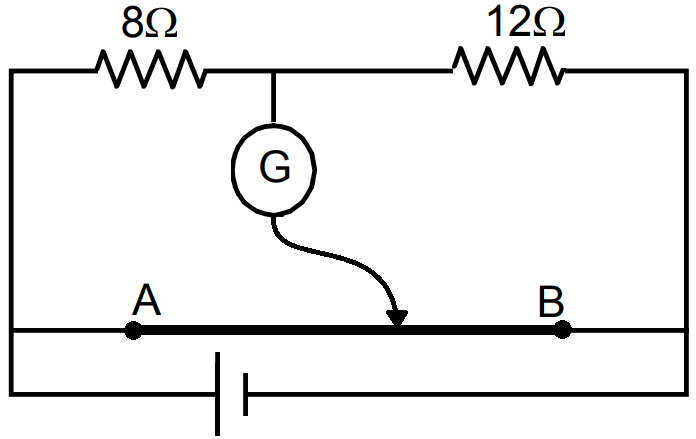
The potentiometer wire AB shown in the figure. is 40cm long. Where should the free end of the galvanometer be connected on AB so that the galvanometer may show zero deflection?

A particle of mass 1g and charge 2.5 × 10-4C is released from rest in an electric field of 1.2 × 104NC-1.
  1. Find the electric force and the force of gravity acting on this particle. Can one of these forces be neglected in comparison with the other for approximate analysis?
  2. How long will it take for the particle to travel a distance of 40cm?
  3. What will be the speed of the particle after travelling this distance?
  4. How much is the work done by the electric force on the particle during this period?
A long, straight wire is fixed horizontally and carries a current of 50.0A. A second wire having linear mass density 1.0 × 10⁻⁴kg/m is placed parallel to and directly above this wire at a separation of 5.0mm. What current should this second wire carry such that the magnetic repulsion can balance its weight?
Define mean value and root mean square value of alternating current.