MCQ
In Birkeland-Eyde process, the raw material used is
  • $Air$
  • B
    $N{H_3}$
  • C
    $N{O_2}$
  • D
    $HN{O_3}$

Answer

Correct option: A.
$Air$
a
(a) Birkeland -Eyde process

Dinitrogen is prepared commercially from air by liquification and fractional distillation. When liquid air is allowed to distil, dinitrogen having lower b.pt ($77\,K$) distils over first leaving behind liquid oxygen (bpt $90\,K$). World wide production of dinitrogen from liquid air is more than $50$ million tonns per year.

Need a full question paper?

Generate a complete, print-ready paper with questions like this in minutes — across 16+ boards, with answer keys.
Start Generating Free

Similar questions

Which of the following compound is optically active?
Which of the following species must have maximum number of electrons in $'d_{xy}$ ;  orbital ?
A complex containing $K^+, Pt(IV)$ and $Cl^-$ is $100\%$ ionised giving $i = 3$. Thus,  possible complex is 
A solution of sodium sulphate contains $92\, g$ of $Na^+$ ions per kilogram of water. The Molality of $Na^+$ ions in that solution in $mol\, kg^{-1}$ is
If the nitrogen atom had electronic configuration $1s^7,$ it would have energy lower than of the normal ground state configuration $1s^2 ,2s^2 ,2 p^3$ because the electron would be closer to the nucleus. Yet $1s^7$ is not observed because it violates
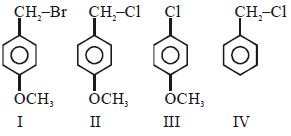
Order of rate of $S_N1$ reactivity for following compound is
When $0.01\,mole$ of sugar is dissolved in $100\,g$ of a solvent, the depression in freezing point is ${0.40\,^o}$. When $0.03\,mole$ of glucose is dissolved in $50\,g$ of the same solvent, the depression in freezing point will be .........$^oC$.
From the following ${E^o}$ values of half cells, what combination of two half cells would result in a cell with the largest potential ?

$\left( I \right)A + {e^ - } \to {A^\circleddash  }\,\,\,\,\,\,{E^o} =  + 0.24\,V$

$\left( {II} \right){B^ - } + {e^ - } \to {B^{ - 2}}\,\,\,\,\,\,{E^o} =  + 1.25\,V$

$\left( {III} \right){C^ - } + 2{e^ - } \to {C^{ - 3}}\,\,\,\,\,\,{E^o} =  + 0.15\,V$

$\left( {IV} \right)D + 2{e^ - } \to {D^{ - 2}}\,\,\,\,\,\,{E^o} =  + 0.68\,V$

The compound with the highest degree of covalency is
For the reaction ${I_2} + 2{S_2}O_3^{2 - }\rightarrow  2{I^ - } + {S_4}O_6^{2 - }$,Correct option is