MCQ
In electrophilic substitution reaction nitrobenzene is
  • A
    Para-directing
  • B
    Ortho-directing
  •  Meta-directing
  • D
    Not reactive and does not undergo any substitution
Answer

Correct option: C.
 Meta-directing
c
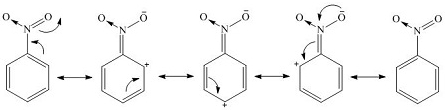
Nitrobenzene is meta-directing for an electrophilic substitution reaction since it has an electron-withdrawing group (i.e $NO _2$ ). There is less electron density at ortho- and para- position and more electron density at meta- position. That's why it is meta directing.

Need a full question paper?

Generate a complete, print-ready paper with questions like this in minutes — across 16+ boards, with answer keys.

Start Generating Free

Similar questions

Photoelectric effect shows :
For the first order reaction, half life is $14\,sec$. The time required for the initial concentration to reduce to $\frac{1}{8}\,th$ of its value is  .......... $\sec$
Which among the following electron transition $(n_2 → n_1)$ in $H-$ atom, minimum change in its orbit radius $(r_2 - r_1) $ is observed-
When sugar ' $X$ ' is boiled with dilute $H _{2} SO _{4}$ in alcoholic solution, two isomers ' $A$ ' and ' $B$ ' are formed. $'A'$ on oxidation with $HNO _{3}$ yields saccharic acid where as ' $B$ ' is laevorotatory. The compound ' $X$ ' is ....... .
The $pH$ of blood does not appreciably change by a small addition of acid or a base because blood
Assertion : $HClO_4$ is a strong acid than $HClO_3$.

Reason : Oxidation state of $Cl$ in $HClO_4$ is $+7$ and in $HClO_3$, it is $+ 5$.
In a chemical reaction $A$ is converted into $B$ . The rates of reaction, starting with initial concentrations of $A$ as $2 \times {10^{ - 3}}\,M$ and $1 \times {10^{ - 3}}\,M$ , are equal to $2.40 \times {10^{ - 4}}\,M{s^{ - 1}}$ and $0.60 \times {10^{ - 4}}\,M{s^{ - 1}}$ respectively. The order of reaction with respect to reactant $A$ will be
The internal energy of a substance
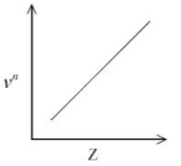
It is observed that characteristic X-ray spectra of elements show regularity. When frequency to the power ' $n$ ' i.e. $v^{ n }$ of X-rays emitted is plotted against atomic number ' $Z$ ', following graph is obtained. The value of ' $n$ ' is
The ratio of the radius of the first three Bohr orbits is