MCQ
In ethers, the  $C -O -C$  bond angle is ........ $^o$
  • A
    ${180}$
  • B
    ${90}$
  • ${110}$
  • D
    ${160}$

Answer

Correct option: C.
${110}$
c
Oxygen atom in ether is $sp ^3$ hybridised, therefore has tetrahedral geometry where two positions are occupied by lone pair of electrons and the other two by the alkyl groups in ether. The bond angle in regular tetrahedral is $109^{\circ} 28^{\prime}$. In general, the lone pairs on $O$ tend to repel the bond pairs and results in lower bond angles than $109^{\circ}$ but in ethers the $C - O - C$ bond angle is slightly more than this i.e nearly $110^{\circ}$. This is because of the presence of bulky alkyl group on $O$ atom that repel each other and counterbalance the repulsion due to lone pair on $O$ atom on bond pairs and results in bond angle slightly greater than tetrahedral angle.Thus, C-O-C bond angle in ether is about $110^{\circ}$.

Need a full question paper?

Generate a complete, print-ready paper with questions like this in minutes — across 16+ boards, with answer keys.

Start Generating Free

Similar questions

Which of the following alkyl halides give most complex mixture of alkene in an $E_2$ reaction ?
The number of enantiomeric pairs possible for the complex having general formula $[M(AB)_3]$ with coordination number $6$ is
At a certain temperature, the vapour pressure of water is $50\ mm.$ The relative lowering of vapour pressure of a solution containing $36g$ of glucose in $900g$ of water is:
The Henry law constant for dissolution of a gas in aqueous medium is $3 × 10^2$  $atm$. At what partial pressure of the gas, the molality of gas in aqueous solution will be $\frac{5}{9}\,m$.
The pair not correctly matched is
All noble gases are:
An aqueous solution contains $6\%$ and $4 \%$ by weight weak acid $(HA)$ and urea respectively. If depression in freezing point $ \frac{{13.6}}{3}\,^oC$. $K_a$ of $CH_3COOH$ will be [$K_f = 1.8 \,\,K-Kg/mole$]

(Molecular wight of $HA= 60, \,d_{solution} = 1\,gm/ml$)
Indicate the incorrect statement:
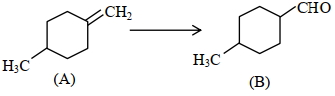
Which of the following reagents$/$ reactions will convert $'A'$ to $'B'$?
For the cell $\mathrm{Cu}(\mathrm{s})\left|\mathrm{Cu}^{2+}(\mathrm{aq})(0.1 \mathrm{M}) \| \mathrm{Ag}^{+}(\mathrm{aq})(0.01 \mathrm{M})\right| \mathrm{Ag}(\mathrm{s})$ the cell potential $\mathrm{E}_{1}=0.3095\, \mathrm{~V}$

For the cell $\mathrm{Cu}(\mathrm{s})\left|\mathrm{Cu}^{2+}(\mathrm{aq})(0.01 \mathrm{M}) \| \mathrm{Ag}^{+}(\mathrm{aq})(0.001 \mathrm{M})\right| \mathrm{Ag}(\mathrm{s})$ the cell potential $=.....\times 10^{-2} \mathrm{~V}$

(Round off to the Nearest Integer).

[Use: $\frac{2.303 \mathrm{RT}}{\mathrm{F}}=0.059$ ]