MCQ
In forward biasing of the $p-n$ junction
  • A
    the positive terminal of the battery is connected to $p-$ side and the depletion region becomes thick.
  • B
    the positive terminal of the battery is connected to $n-$ side and the depletion region becomes thick.
  • C
    the positive terminal of the battery is connected to $n-$ side and the depletion region becomes thin.
  • the positive terminal of the battery is connected to $p-$ side and the depletion region becomes thin.
Answer

Correct option: D.
the positive terminal of the battery is connected to $p-$ side and the depletion region becomes thin.
d
In forward biasing, the positive terminal of the battery is connected to $p-$side and the negative terminal to $n-$side of $p-n$ junction. The fmward bias voltage opposes the potential barrier. Due to it, the depletion region becomes thin.

Need a full question paper?

Generate a complete, print-ready paper with questions like this in minutes — across 16+ boards, with answer keys.

Start Generating Free

Similar questions

The output of a dynamo using a splitting commutator is
The energy consumed in $1\, Kwatt$ electric heater in $30$ seconds will be
Assertion : Diamagnetic materials can exhibit magnetism.

Reason : Diamagnetic materials have permanent magnetic dipole moment.

Assertion : An ac generator is based on the phenomenon of self-induction.
Reason : In single coil, we consider self-induction only.
The half life (T) and the disintegration constant (λ) of a radioactive substance are related as
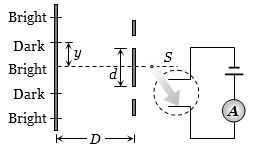
In the following arrangement $y = 1.0\ mm$, $d= 0.24\ mm$ and $D = 1.2\ m$. The work function of the material of the emitter is $2.2\ eV.$ The stopping potential $V$ needed to stop the photo current will be .............. $V$
A monochromatic beam of light of wavelength $400\,nm$ incident normally upon a photosensitive surface ($25\%$ reflects and rest absorbs), produces a pressure of $5 \times 10^{-7}\,Nm^{-2}$ on it. If $0.1\%$ of the incident photons produce electrons then corresponding saturation current will be..............$\mu A$ (consider area of photosensitive surface $= 5\,cm^2$)
A $5\, \mu F$ capacitor is charged fully by a $220\,V$ supply. It is then disconnected from the supply and is connected in series to another uncharged $2.5\;\mu F$ capacitor. If the energy change during the charge redistribution is $\frac{ X }{100} \;J$ then value of $X$ to the nearest integer is$.....$
Equal charges are given to two spheres of different radii. The potential will
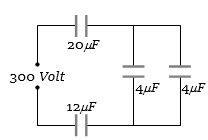
In the adjoining figure, four capacitors are shown with their respective capacities and the $P.D.$ applied. The charge and the $P.D.$ across the $4\,\mu F$ capacitor will be